
Loading...

Understanding Event Loop & Async Behavior in Node.js

Understanding Event Loop & Async Behavior in Node.js

Divya Pal

26 September, 2025


Node.js is known for its speed and efficiency, but the real magic powering it is the Event Loop. Since Node.js runs on a single thread, understanding how the Event Loop manages asynchronous tasks is essential to writing performant applications. In this blog, we’ll explore how the Event Loop works, how async operations are handled, and why Node.js excels at non-blocking I/O.

What is the Event Loop?

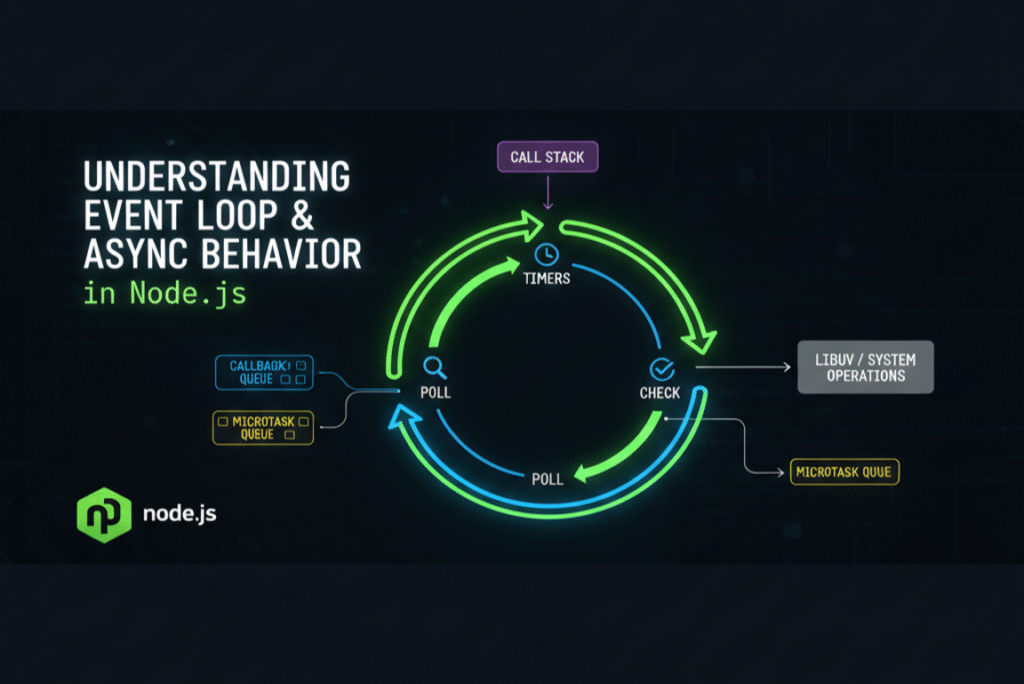
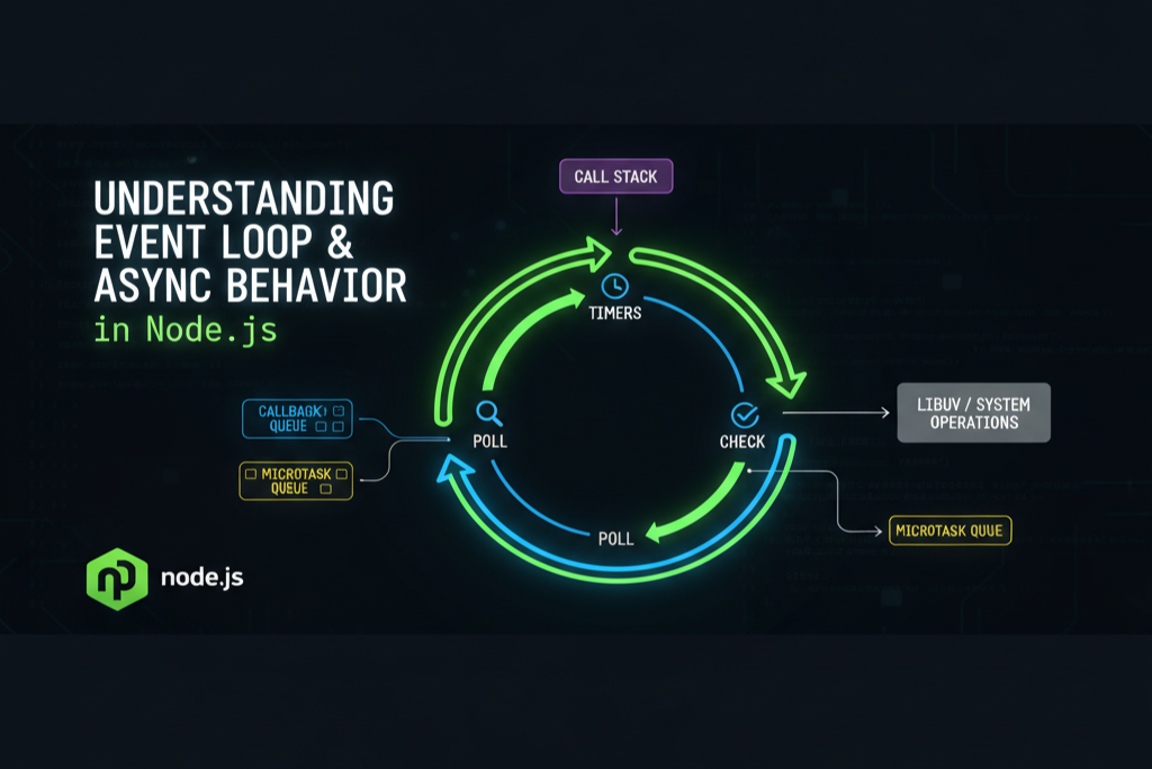
The Event Loop is the core mechanism in Node.js that handles asynchronous operations. Although Node.js runs JavaScript in a single thread, it can still perform heavy I/O tasks without blocking the execution, thanks to the Event Loop and the underlying libuv library.

How the Event Loop Works

When Node.js receives asynchronous tasks — such as database queries, timers, or network calls — it delegates them to background threads managed by libuv. Once those operations are completed, callbacks are pushed back to the Event Loop for execution.

Phases of the Event Loop

The Event Loop cycles through multiple phases:

  • Timers: Executes callbacks from setTimeout and setInterval.
  • Pending Callbacks: Executes deferred I/O callbacks.
  • Idle & Prepare: Internal use only.
  • Poll: Retrieves new I/O events and executes I/O callbacks.
  • Check: Executes setImmediate callbacks.
  • Close Callbacks: Executes close event callbacks like socket.on('close').

Async Patterns in Node.js

1. Callbacks

Initially, async operations were handled with callbacks. While this worked, it often led to nested and hard-to-read code, known as callback hell.

2. Promises

Promises introduced a cleaner way to handle async flows using .then() and .catch(), reducing nested callbacks and improving readability.

3. Async/Await

Async/Await builds on top of promises and allows asynchronous code to be written like synchronous code. It’s now the most popular pattern in Node.js.

4. Event Emitters

EventEmitters allow multiple listeners to respond to events, making it ideal for real-time features like chat apps and notifications.

5. Streams

Streams process data in chunks, making them highly efficient for handling large files or continuous data flows.

Best Practices for Working with Async Code

1. Avoid Blocking the Event Loop

CPU-heavy computations should be moved to worker threads. Blocking the Event Loop reduces performance and scalability.

2. Use Promise.all for Parallel Async Tasks

If tasks are independent, run them in parallel to reduce execution time.

3. Always Handle Errors

Use try/catch with async/await or .catch() with promises to prevent crashes.

4. Utilize Performance Tools

Tools like clinic.js, pm2, and Node.js inspector help analyze and optimize performance.

Conclusion

Understanding the Event Loop is essential for mastering Node.js performance. By leveraging async patterns correctly and avoiding blocking operations, you can build scalable, fast, and efficient applications. The better you understand how Node.js handles async tasks, the more powerful your applications will become.

RECENT POSTS

How to Plan a Phased ERP or CRM Implementation Without Breaking Your Business

Every NBFC or fintech CTO we’ve worked with at Speqto has asked some version of the same question: “Can we just go live in one shot?” The honest answer is almost always no. We’ve seen a mid-sized housing finance company try a big-bang CRM rollout across 40 branches in one weekend, and by Monday morning, […]

Why Microservices Architecture Reduces Long-Term Maintenance Cost (And What BFSI Leaders Should Know Before Migrating)

A few months back, we sat down with the CTO of a mid-sized NBFC who was paying nearly ₹40 lakhs a year just to keep their loan origination system running. Not building new features. Not scaling. Just keeping the lights on. That conversation is the reason this post exists. At Speqto Technologies, we’ve rebuilt enough […]

Building Customer-Facing Portals for Financial Institutions: What Actually Works

Over the last few years, we at Speqto Technologies have built and re-built more banking, NBFC, and insurance portals than we can count on two hands. And if there’s one thing every project taught us, it’s this: a customer portal for a financial institution is not just another web application. It’s the digital front door […]

How AI Can Improve Fraud Detection in Banking Systems: A Practical Look

A few months ago, a mid-sized NBFC we work with flagged something odd: their rule-based fraud engine was catching barely 22% of confirmed fraud cases, and worse, it was blocking nearly 8% of genuine transactions. Customers were getting locked out of their own accounts while actual fraudsters slipped through with transaction patterns that just barely […]

7 Signs Your Software Vendor Has Become the Bottleneck, Not the Solution

A few months back, a mid-sized NBFC we work with at Speqto Technologies came to us with a problem that sounded almost embarrassing to admit out loud: their loan origination system took 11 days to add a single new field to a form. Not a new feature. A form field. Their vendor’s change request queue […]

POPULAR TAG

POPULAR CATEGORIES