

Loading...

REST vs GraphQL vs tRPC: Performance, Caching, and DX Compared with Real-World Scenarios

REST vs GraphQL vs tRPC: Performance, Caching, and DX Compared with Real-World Scenarios

Shubham Anand

29-Oct-2025

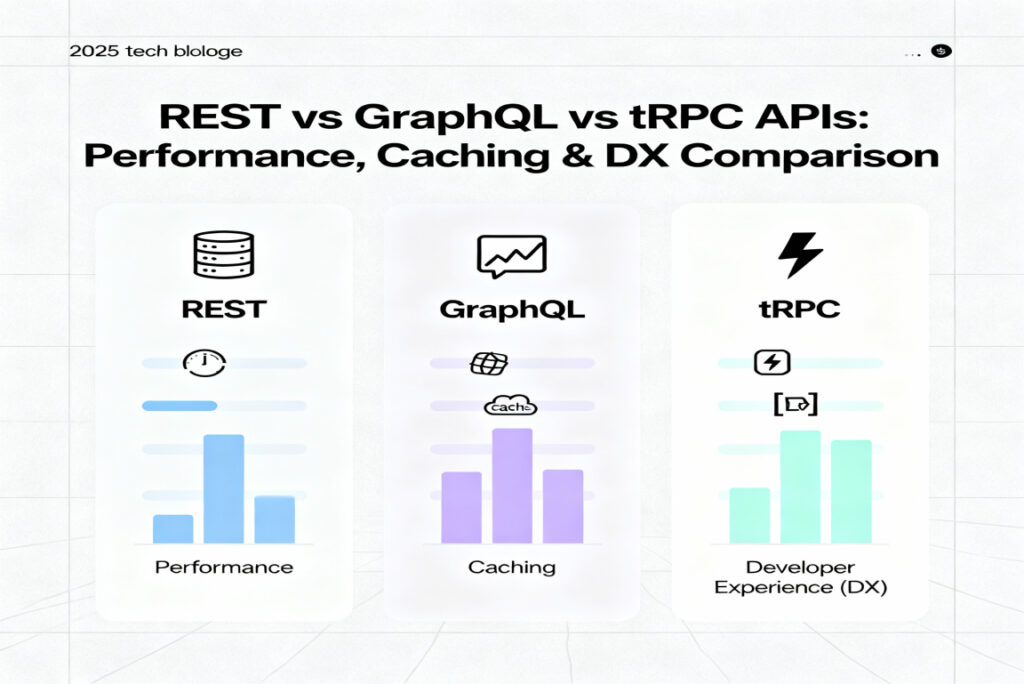
API architecture selection—REST, GraphQL, and tRPC—directly impacts an application’s performance, caching, and developer experience (DX). In 2025, understanding how each performs in real-world scenarios is critical for teams seeking the right balance between reliability and agility.

1. REST: The Reliable Veteran

    • Performance: Built on HTTP standards, REST remains fast for basic CRUD and resource-driven APIs. However, over-fetching and under-fetching can slow down complex queries.
    • Caching: Excels with mature HTTP caching mechanisms supported natively by proxies and browsers.
    • Developer Experience: Familiar, language-agnostic, and easy to debug. But scaling advanced UIs or joining multiple resources can create boilerplate and inefficiency.
    • Real-world use: E-commerce catalogs, industry-standard public APIs, simple mobile backends.

2. GraphQL: The Flexible Powerhouse

  • Performance: Allows clients to request only what they need, reducing over-fetching. However, may introduce performance hits for simple fetches due to parsing and resolver depth (e.g., 1864ms avg. latency vs 923ms for REST on simple queries, but excels in complex data fetching).
  • Caching: HTTP caching is non-trivial, but clients can use advanced client-side normalized caches or persistent queries for speed.
  • Developer Experience: Strongly typed schemas; boosts productivity (62% of teams report increased DX). Great for frontends and evolving UI needs, but can be overkill for simple data needs.
  • Real-world use: Social media feeds, dashboards aggregating many sources, mobile and SPA UIs for rich data presentation.

3. tRPC: The TypeScript Specialist

  • Performance: Minimal overhead, highly performant with binary and multiplexed transport (HTTP/2), and leverages end-to-end type safety for faster development. Typically matches or beats REST and GraphQL in Node/TypeScript apps.
  • Caching: Relies on custom strategies, such as HTTP cache headers or client-side solutions; less out-of-the-box support than REST, more flexibility for tailored needs.
  • Developer Experience: Automatic type safety from client to server with zero codegen. Minimal boilerplate, instant feedback, and ideal for TypeScript monorepos. Not suitable for polyglot or public APIs.
  • Real-world use: Internal admin panels, rapid prototyping, modern TypeScript SaaS dashboards, modular architectures with fast inter-service communication.

4. Scenario-Based Comparison

  • Public API for Third-Party Devs: REST provides simplicity and broad compatibility. Caching and documentation are straightforward. GraphQL can be added for advanced clients.
  • Complex Enterprise Dashboard: GraphQL shines when aggregating multiple sources and delivering nested, precise data for UIs. Caching and performance require planning but front-end teams thrive.
  • Internal Tools/Monorepos: tRPC offers unmatched type safety, rapid iteration, and minimal overhead, ideal for TypeScript-first teams and tight client-server coupling.

5. Summary Table

Feature REST GraphQL tRPC
Performance Fast (esp. simple CRUD) Best for complex data, may lag for simple fetches Fastest for TS monorepos, minimal overhead
Caching Native HTTP caching Advanced client-side caching Custom/Client-side
Type Safety Manual/Optional Schema-based, not end-to-end Automatic (TypeScript-first)
DX (Developer Experience) Simple, language-agnostic Schema-driven, productive in rich UIs Zero-boilerplate, instant TS types
Best Use Case Public APIs, CRUD Complex, aggregative UIs Internal tools, TS stacks

Conclusion

In practice, there’s no single winner—REST, GraphQL, and tRPC each excel under different circumstances. REST’s simplicity makes it great for public APIs; GraphQL empowers rich, flexible frontends; tRPC accelerates internal apps in TypeScript ecosystems. The technical and business needs of your project should drive your API architecture decision.

RECENT POSTS

How Blockchain Is Quietly Entering Mainstream BFSI Operations

Nobody in banking wants to talk about blockchain anymore — at least not the way they did in 2018, when every conference deck had a slide promising to “disrupt finance forever.” That noise has died down. But something quieter and more useful has taken its place: banks, NBFCs, and insurers are actually using distributed ledger […]

Smart Contract Security: What Businesses Must Verify Before Launch

Last year, a mid-sized lending platform in the UAE lost close to $2.3 million because of a single unchecked reentrancy pattern in their loan disbursement contract. The code had passed two internal reviews. It looked clean. It wasn’t. This is the kind of story that keeps BFSI and fintech leaders up at night, and honestly, […]

Building a Wallet or Points-Based Loyalty System for Fintech: What Actually Works

Every fintech founder we talk to eventually asks the same question: “Should we build a wallet-based rewards system or a points-based one?” It sounds like a small product decision, but it shapes your compliance load, your tech architecture, and honestly, how fast you can ship features later. At Speqto Technologies, we’ve built both types for […]

What CTOs Should Ask Before Hiring an Offshore Dev Team (Especially in BFSI and Fintech)

A few months back, a VP of Engineering at a mid-sized lending platform told us something that stuck: “We didn’t lose money because the offshore team couldn’t code. We lost money because nobody asked who owns the AWS root account.” That one sentence captures most of what goes wrong in offshore hiring decisions. It’s rarely […]

Reducing Loan Processing Time Through Workflow Automation: What Actually Works in BFSI

Every NBFC and fintech lender we’ve worked with at Speqto Technologies starts with the same complaint: loan files are stuck somewhere between “submitted” and “disbursed,” and nobody can say exactly where or why. Not because the team is slow, but because the process is scattered across emails, PDFs, spreadsheets, and three different logins that don’t […]

POPULAR TAG

POPULAR CATEGORIES