
Loading...

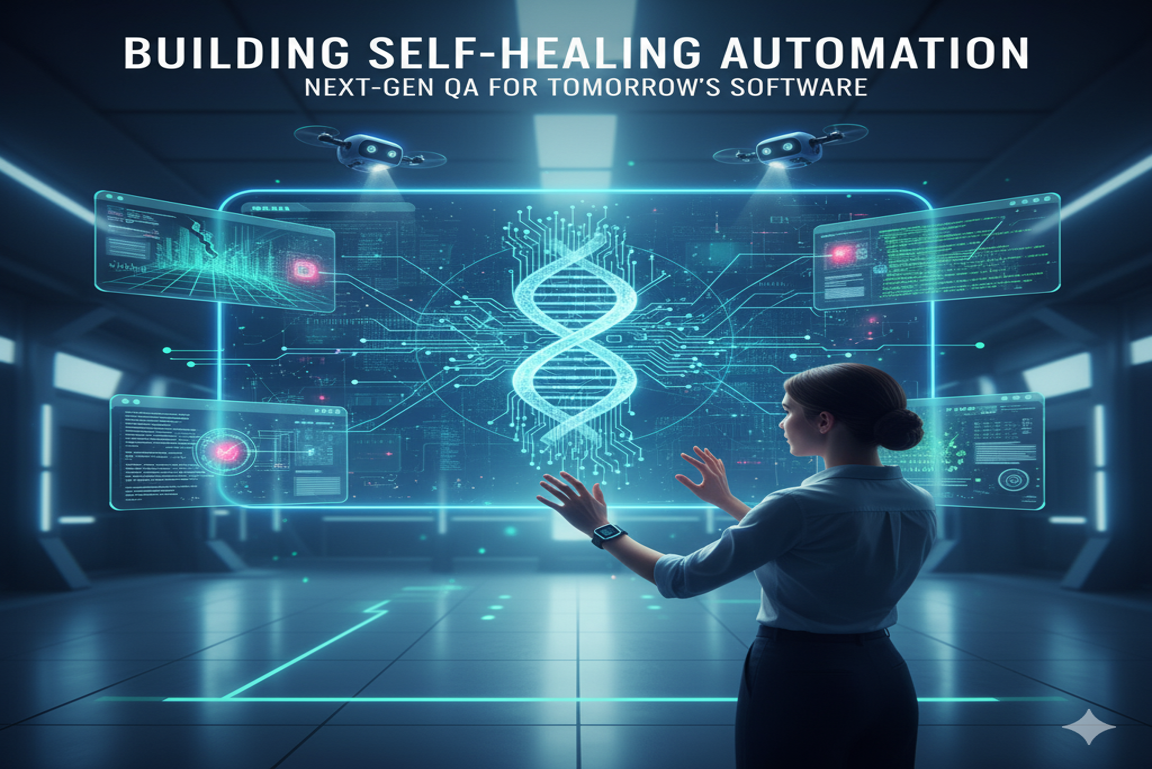
Building Self-Healing Automation: Next-Gen QA for Tomorrow’s Software

Building Self-Healing Automation: Next-Gen QA for Tomorrow’s Software

Megha Srivastava

31 October 2025

self-healing automation QA

Traditional automated testing faces a critical challenge: constant application changes break scripts, overwhelm QA teams, and turn continuous testing into a nightmare of endless fixes. The answer? Self-healing automation—a breakthrough approach leveraging AI and machine learning to automatically adapt and repair broken tests in real-time, slashing maintenance efforts and transforming quality assurance into a proactive, resilient force for tomorrow’s software.

In this blog, discover how self-healing automation not only sustains test coverage through continuous delivery but also empowers QA teams to focus on higher-value tasks. Explore the powerful strategies, practical examples, and next-gen tools redefining how modern organizations achieve reliable, scalable software testing.

Why Self-Healing Automation is a Game Changer

With CI/CD pipelines and daily code changes now the norm, the biggest bottleneck in QA is keeping tests up-to-date. Studies show teams spend up to 70% of their effort just maintaining automated tests, which defeats their purpose. Self-healing automation reverses this—with AI systems identifying, diagnosing, and fixing broken tests instantly, QA teams regain productivity and ensure truly continuous testing without constant patchwork.

How Self-Healing Automation Works

Modern self-healing frameworks continuously monitor application elements (like XPaths, CSS selectors, labels), learning patterns, and storing a “fingerprint” of each target element. When a locator fails—say, a button ID changes or an element moves—the system searches for alternative attributes, applies fuzzy matching, and leverages past healing data. The test script is auto-corrected and resumes execution without human intervention.

Key Mechanisms:

  • AI and ML analyze DOM changes, anticipate element replacements, and auto-update locators.
  • Contextual awareness matches elements using surrounding structure and semantic clues.
  • Continuous learning from healing events improves future accuracy.
  • Human oversight ensures fixes align with business logic, maintaining genuine error detection.
 Example: A payment button labelled confirmButton becomes purchaseConfirmButton after a new release. Traditional tests fail. Self-healing automation matches context, updates the locator automatically, and the test passes without disruption. 

Advanced Techniques & Practical Scenarios

Dynamic Waits: Self-healing frameworks adjust wait times based on element readiness, preventing failures due to timing issues.

API Testing: Self-healing modifies verification logic for API responses and structures, instantly adapting to schema updates.

Object Repository Healing: Automated frameworks maintain multiple locators per element, switching seamlessly if primary keys break.

Full Pipeline Integration: Self-healing is embedded into CI/CD flows, supporting zero-touch deployments and rollback on detection of genuine failures.

Best Practices for Success

  • Choose AI-driven automation tools with robust self-healing features (like DogQ, Virtuoso, Selenium with AI plugins).
  • Write flexible scripts that use multiple locator strategies.
  • Prioritize high-risk, frequently changing components for maximum coverage and stability.
  • Regularly review auto-healed scripts for business alignment—automation augments, not replaces, expert QA judgment.

Benefits: Transforming the QA Workflow

  • Minimized manual test maintenance—up to 80% less routine work.
  • Faster release cycles and higher coverage.
  • Reduced flakiness, stronger reliability for dynamic applications.
  • More time for exploratory testing and strategic quality improvements.

Conclusion: The Self-Healing Future of QA

Self-healing automation delivers the long-awaited promise of truly continuous testing. By combining intelligent, proactive adaptation with the rigor of human oversight, QA teams will drive software quality higher than ever before—unburdened by endless fixes, empowered to focus on innovation, and ready for the rapidly evolving demands of tomorrow’s software landscape.

Frequently Asked Questions

Q: Will self-healing automation replace QA engineers?
A: No—self-healing tools empower QA professionals, reducing repetitive maintenance while freeing time for in-depth, creative testing.

Q: What tools enable self-healing automation?
A: DogQ, Virtuoso, Selenium with AI plugins, and modern AI-powered frameworks lead the space for self-healing functionality.

Q: Are there risks to automated healing?
A: While powerful, healing can mask real defects. Always review critical flows and pair automation with human judgment.

Related Resources

Explore our guides on AI-Powered Testing and DevOps for QA Automation to further future-proof your quality assurance strategy.

Ready to build a future-proof QA strategy? Partner with Speqto’s automation experts to design resilient, self-healing test suites for your projects. Contact our consulting team today for a free consultation.

RECENT POSTS

The $40,000 Handover: What Happens When Outsourced Projects Don’t Document Anything

A few years back, we picked up a project midway for a BFSI client — a mid-sized NBFC that had built a loan origination system with another vendor. The vendor was gone. The developers were gone. What remained was a working application, a production server, and absolutely nothing explaining how any of it fit together. […]

The First 30 Days: How Speqto Actually Onboards a New BFSI Client

Most agencies talk about “seamless onboarding” and then send you a generic questionnaire on day one. We’ve built our first 30 days differently, mostly because we learned the hard way what happens when you skip the boring parts on a fintech project. A couple of years ago, we started work with a Pune-based NBFC that […]

Why BFSI Software Projects Blow Past Budget (And What We Do Differently at Speqto)

Every fintech founder or BFSI IT head has heard some version of this line at least once: “We’re 60% over budget, and we’re still not live.” It’s such a common story that most people assume it’s just how software works. It isn’t. In our years of building lending platforms, KYC systems, and payment gateways, we’ve […]

Building Compliant KYC and Onboarding Systems for BFSI Clients: What Actually Works

Har dusre BFSI client ke saath jab hum discovery call karte hain, ek hi sawaal repeat hota hai: “Hamara onboarding drop-off rate 40% se upar kyun hai, jabki hum RBI/SEBI compliant hain?” Ye sawaal apne aap mein problem bata deta hai — compliance aur user experience ko log alag-alag silos mein treat karte hain, jabki […]

Reducing Customer Churn Through Better Digital Onboarding Flows

Most BFSI and fintech companies lose customers before they’ve even used the product. Not because of pricing, not because of a competitor’s better feature — but because the onboarding flow made someone give up on step 4 of 9. We’ve seen this pattern across almost every lending, insurance, and neobanking client we’ve worked with at […]

POPULAR TAG

POPULAR CATEGORIES