
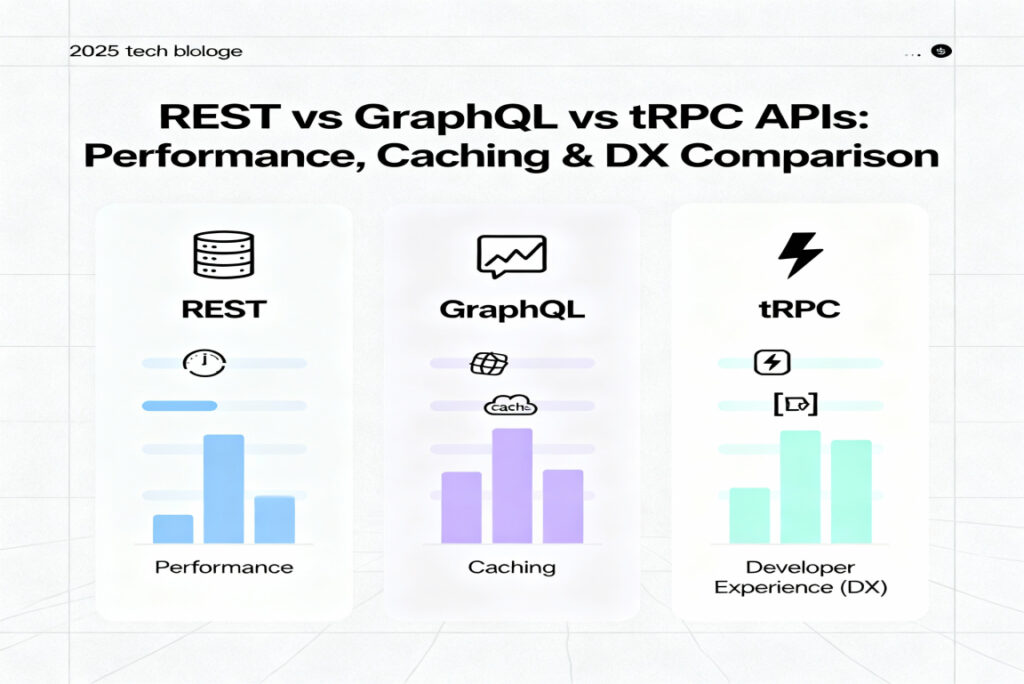
REST vs GraphQL vs tRPC: Performance, Caching, and DX Compared with Real-World Scenarios
API architecture selection—REST, GraphQL, and tRPC—directly impacts an application’s performance, caching, and developer experience (DX). In 2025, understanding how each performs in real-world scenarios is critical for teams seeking the right balance between reliability and agility.
1. REST: The Reliable Veteran
- Performance: Built on HTTP standards, REST remains fast for basic CRUD and resource-driven APIs. However, over-fetching and under-fetching can slow down complex queries.
- Caching: Excels with mature HTTP caching mechanisms supported natively by proxies and browsers.
- Developer Experience: Familiar, language-agnostic, and easy to debug. But scaling advanced UIs or joining multiple resources can create boilerplate and inefficiency.
- Real-world use: E-commerce catalogs, industry-standard public APIs, simple mobile backends.
2. GraphQL: The Flexible Powerhouse
- Performance: Allows clients to request only what they need, reducing over-fetching. However, may introduce performance hits for simple fetches due to parsing and resolver depth (e.g., 1864ms avg. latency vs 923ms for REST on simple queries, but excels in complex data fetching).
- Caching: HTTP caching is non-trivial, but clients can use advanced client-side normalized caches or persistent queries for speed.
- Developer Experience: Strongly typed schemas; boosts productivity (62% of teams report increased DX). Great for frontends and evolving UI needs, but can be overkill for simple data needs.
- Real-world use: Social media feeds, dashboards aggregating many sources, mobile and SPA UIs for rich data presentation.
3. tRPC: The TypeScript Specialist
- Performance: Minimal overhead, highly performant with binary and multiplexed transport (HTTP/2), and leverages end-to-end type safety for faster development. Typically matches or beats REST and GraphQL in Node/TypeScript apps.
- Caching: Relies on custom strategies, such as HTTP cache headers or client-side solutions; less out-of-the-box support than REST, more flexibility for tailored needs.
- Developer Experience: Automatic type safety from client to server with zero codegen. Minimal boilerplate, instant feedback, and ideal for TypeScript monorepos. Not suitable for polyglot or public APIs.
- Real-world use: Internal admin panels, rapid prototyping, modern TypeScript SaaS dashboards, modular architectures with fast inter-service communication.
4. Scenario-Based Comparison
- Public API for Third-Party Devs: REST provides simplicity and broad compatibility. Caching and documentation are straightforward. GraphQL can be added for advanced clients.
- Complex Enterprise Dashboard: GraphQL shines when aggregating multiple sources and delivering nested, precise data for UIs. Caching and performance require planning but front-end teams thrive.
- Internal Tools/Monorepos: tRPC offers unmatched type safety, rapid iteration, and minimal overhead, ideal for TypeScript-first teams and tight client-server coupling.
5. Summary Table
| Feature | REST | GraphQL | tRPC |
|---|---|---|---|
| Performance | Fast (esp. simple CRUD) | Best for complex data, may lag for simple fetches | Fastest for TS monorepos, minimal overhead |
| Caching | Native HTTP caching | Advanced client-side caching | Custom/Client-side |
| Type Safety | Manual/Optional | Schema-based, not end-to-end | Automatic (TypeScript-first) |
| DX (Developer Experience) | Simple, language-agnostic | Schema-driven, productive in rich UIs | Zero-boilerplate, instant TS types |
| Best Use Case | Public APIs, CRUD | Complex, aggregative UIs | Internal tools, TS stacks |
Conclusion
In practice, there’s no single winner—REST, GraphQL, and tRPC each excel under different circumstances. REST’s simplicity makes it great for public APIs; GraphQL empowers rich, flexible frontends; tRPC accelerates internal apps in TypeScript ecosystems. The technical and business needs of your project should drive your API architecture decision.