Loading...

AR/VR for Enterprise: Where BFSI Leaders Are Actually Seeing ROI in 2024

AR/VR for Enterprise: Where BFSI Leaders Are Actually Seeing ROI in 2024

Ask any BFSI CIO about AR/VR two years ago and you’d get an eye-roll — “nice demo, no business case.” That conversation has changed. At Speqto Technologies, we’ve spent the last 18 months building immersive tech solutions for banking, insurance, and fintech clients, and the pattern is clear: the projects getting funded this year aren’t flashy metaverse branches. They’re narrow, unglamorous use cases that cut training cost, reduce errors, and shorten sales cycles. Here’s what’s actually working.

1. Compliance and Process Training — The Easiest ROI Case in BFSI

This is where we see the fastest payback period, often under 12 months. A mid-sized NBFC we worked with was spending nearly ₹40 lakh a year flying regional branch managers to Mumbai for quarterly compliance refreshers — KYC updates, AML red-flag identification, cash handling protocols. We built a VR module simulating actual branch scenarios: a customer trying to split a large cash deposit to avoid reporting thresholds, a forged document at the counter, a social-engineering call pretending to be from head office.

The numbers that mattered to their board: training time per employee dropped from 2 days to 6 hours, travel cost went to near-zero, and — this is the part that actually got the project renewed — incident-reporting accuracy in the following audit cycle went up because employees had practiced the exact scenario, not just read about it in a PDF.

2. Remote Expert Assistance for IT and Branch Operations

Banks with large branch networks lose real money to downtime on ATMs, core banking terminals, and biometric kiosks. One regional bank client was sending a technician on a 3-4 hour round trip for issues that, half the time, turned out to be something a branch staffer could fix in 10 minutes with the right guidance.

We implemented AR-assisted remote support — branch staff wear a headset or just use a tablet camera, and a technician at the central helpdesk sees exactly what they see, draws arrows and annotations directly on the live feed. Mean time to resolution dropped by roughly 60%, and more importantly, truck rolls for low-complexity issues fell sharply. For a bank running 300+ branches, that’s not a nice-to-have, that’s a line item CFOs notice.

3. Client-Facing Sales — Wealth Management and Insurance

This one surprises people. A wealth management firm we partnered with uses AR visualization during client meetings to show portfolio allocation, projected growth scenarios, and risk exposure as interactive 3D models instead of a static slide deck. Relationship managers reported longer client engagement time in meetings and, more usefully, faster decision-making on recommended products — clients said they “understood where their money was going” in a way spreadsheets never achieved.

In insurance, we’ve built AR tools for claims assessment — an adjuster points a phone camera at vehicle or property damage, and the system overlays estimated repair costs and flags inconsistencies against claim photos submitted by the customer. One mid-size insurer cut claims processing time by nearly 30% and reduced a specific category of fraudulent claims because the overlay made manipulated photos easier to catch.

4. Fintech Onboarding and Customer Education

Fintech apps live and die by activation rates. A lending fintech client used AR-based interactive walkthroughs inside their app — instead of a generic tutorial, first-time users point their camera at their documents and get real-time guided overlays for the loan application process. Drop-off during document upload fell noticeably, and support ticket volume for “how do I upload X” queries dropped too. It’s a small feature, but when you’re acquiring customers at ₹300-500 CAC, a few percentage points of activation improvement moves the unit economics meaningfully.

What’s Not Working (Yet)

To be fair, not everything pays off. Full VR “virtual branches” for retail banking customers — the idea of a customer putting on a headset to open an account — haven’t shown real adoption in our client conversations. Hardware friction is still too high for mainstream retail customers, and most people just want a faster app, not a headset. We’d steer BFSI clients away from consumer-facing VR until headset penetration improves significantly.

What This Means If You’re Evaluating AR/VR Right Now

  • Start with internal, high-frequency, high-cost processes — training and remote support consistently show the clearest ROI.
  • Pick one measurable metric before you build anything — training hours, truck rolls, claims time, activation rate — not “engagement.”
  • Pilot with one region or one branch cluster before network-wide rollout. Every successful project we’ve run started small and scaled after the numbers proved out.
  • Budget for change management, not just tech. The headset is the easy part — getting a 50-year-old branch manager comfortable wearing one takes a plan.

At Speqto, we’ve learned that the enterprises getting real returns from AR/VR aren’t chasing innovation headlines — they’re solving a specific, expensive operational problem and happen to be using immersive tech to do it. If you’re a BFSI or fintech leader trying to figure out where this fits in your roadmap, that’s usually the right place to start: not “should we do AR/VR,” but “what’s our most expensive repeatable process that a visual, hands-on simulation could fix.”

RECENT POSTS

AR/VR for Enterprise: Where BFSI Leaders Are Actually Seeing ROI in 2024

Ask any BFSI CIO about AR/VR two years ago and you’d get an eye-roll — “nice demo, no business case.” That conversation has changed. At Speqto Technologies, we’ve spent the last 18 months building immersive tech solutions for banking, insurance, and fintech clients, and the pattern is clear: the projects getting funded this year aren’t […]


Kubernetes for Non-Technical Founders: What You Actually Need to Know

If you’ve raised a seed round for your fintech or lending platform, chances are someone on your tech team has already said the word “Kubernetes” in a meeting, followed by nods from everyone pretending to understand. We’ve sat in those meetings too — at Speqto Technologies, we build and manage infrastructure for BFSI and fintech […]

BNPL Platform Development: What Indian Fintechs Need to Know Before They Build

Buy Now Pay Later looked like free money for a while. Between 2020 and 2022, every second fintech pitch deck in India had a BNPL slide. Then RBI’s digital lending guidelines landed, a few PPI circulars tightened the screws, and a chunk of that market quietly shrunk or pivoted to “pay in 3” and merchant […]

Reducing Loan Processing Time Through Workflow Automation: What Actually Works

If you’ve spent any time in lending operations, you already know the real cost of a slow loan cycle isn’t just customer frustration — it’s lost business. A borrower who waits 10 days for approval has usually applied with two other lenders in the meantime. We’ve seen this play out repeatedly with our BFSI clients […]

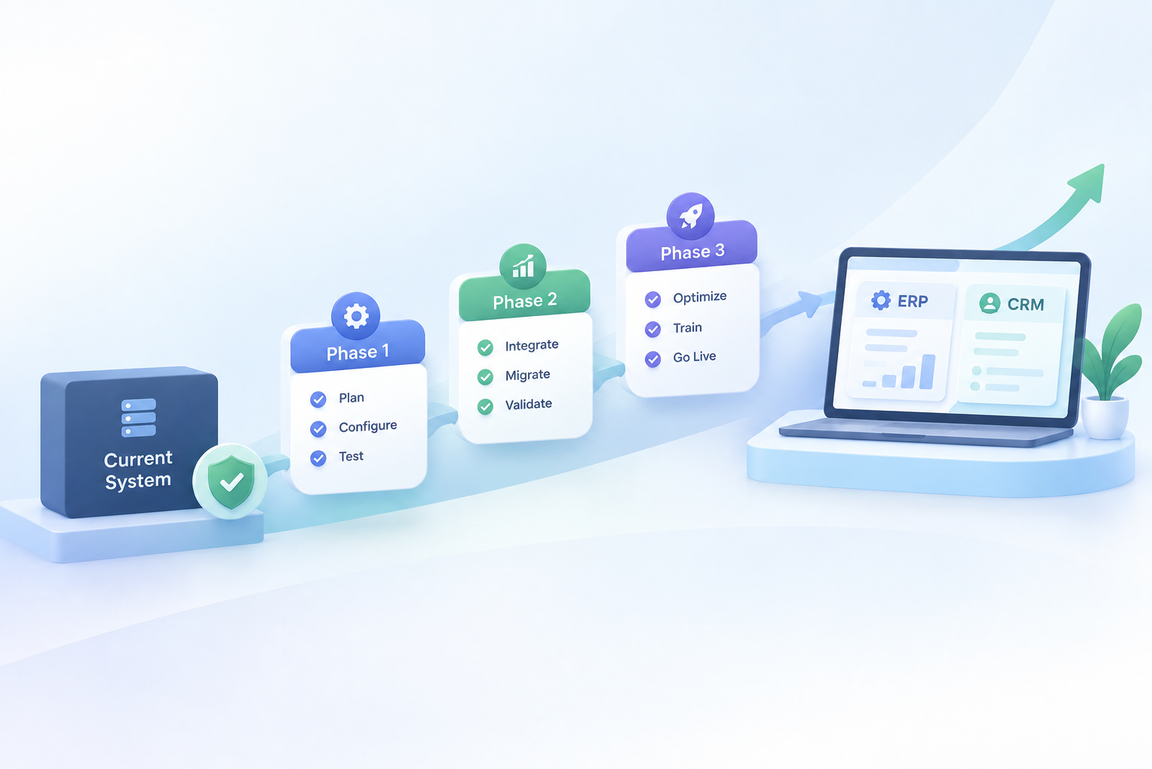
How to Plan a Phased ERP or CRM Implementation Without Breaking What Already Works

Every BFSI or fintech leader we’ve worked with has heard the same horror story at least once — a bank or NBFC switches on a new core system overnight, and for three weeks nobody can process loan disbursements properly. That’s the risk of a “big-bang” ERP or CRM rollout, and it’s exactly why phased implementation […]

POPULAR CATEGORIES