

Loading...

How to Plan a Phased ERP or CRM Implementation Without Breaking What Already Works

How to Plan a Phased ERP or CRM Implementation Without Breaking What Already Works

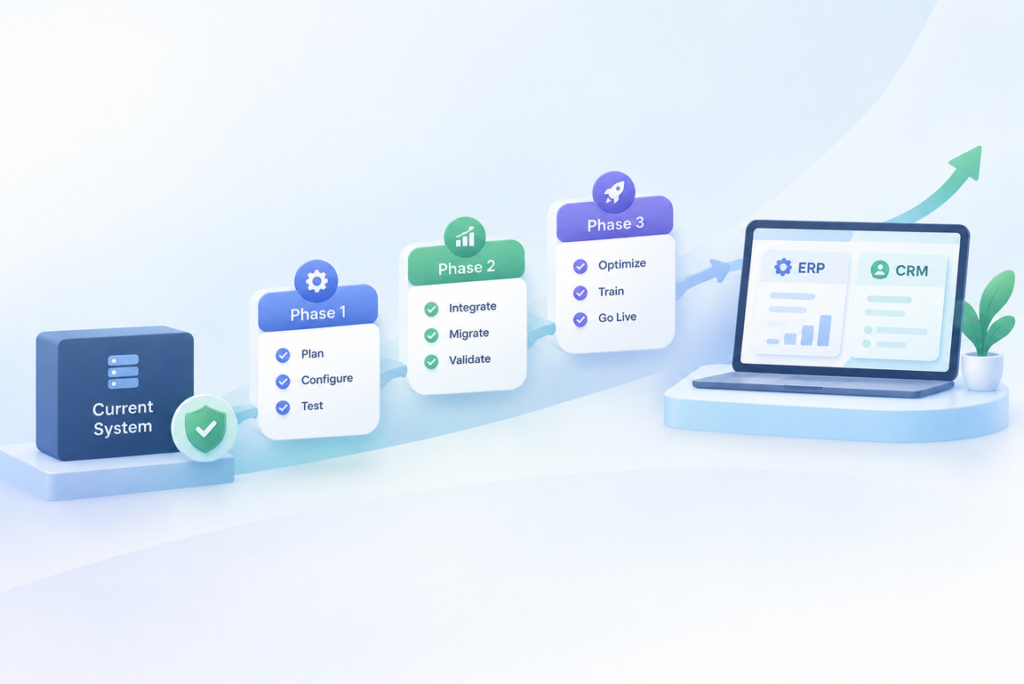
Every BFSI or fintech leader we’ve worked with has heard the same horror story at least once — a bank or NBFC switches on a new core system overnight, and for three weeks nobody can process loan disbursements properly. That’s the risk of a “big-bang” ERP or CRM rollout, and it’s exactly why phased implementation isn’t just a nice-to-have in regulated financial environments — it’s the only sane way to do it.

At Speqto Technologies, we’ve implemented ERP and CRM systems for NBFCs, insurance brokers, and digital lending platforms where even two hours of downtime means compliance flags, customer complaints, or reconciliation nightmares. Here’s how we actually plan these rollouts so they don’t blow up mid-way.

1. Start with process mapping, not software selection

Most failed implementations start backwards — the vendor is chosen before anyone has mapped how loan origination, KYC, or claims processing actually works end to end. We spend the first two to three weeks just shadowing teams: credit ops, collections, compliance, customer service. For one NBFC client processing personal loans, this step alone revealed that their collections team was using WhatsApp and Excel in parallel with the existing CRM — something leadership genuinely didn’t know. No ERP vendor can fix a process gap you haven’t identified.

2. Break the rollout into business-outcome phases, not technical modules

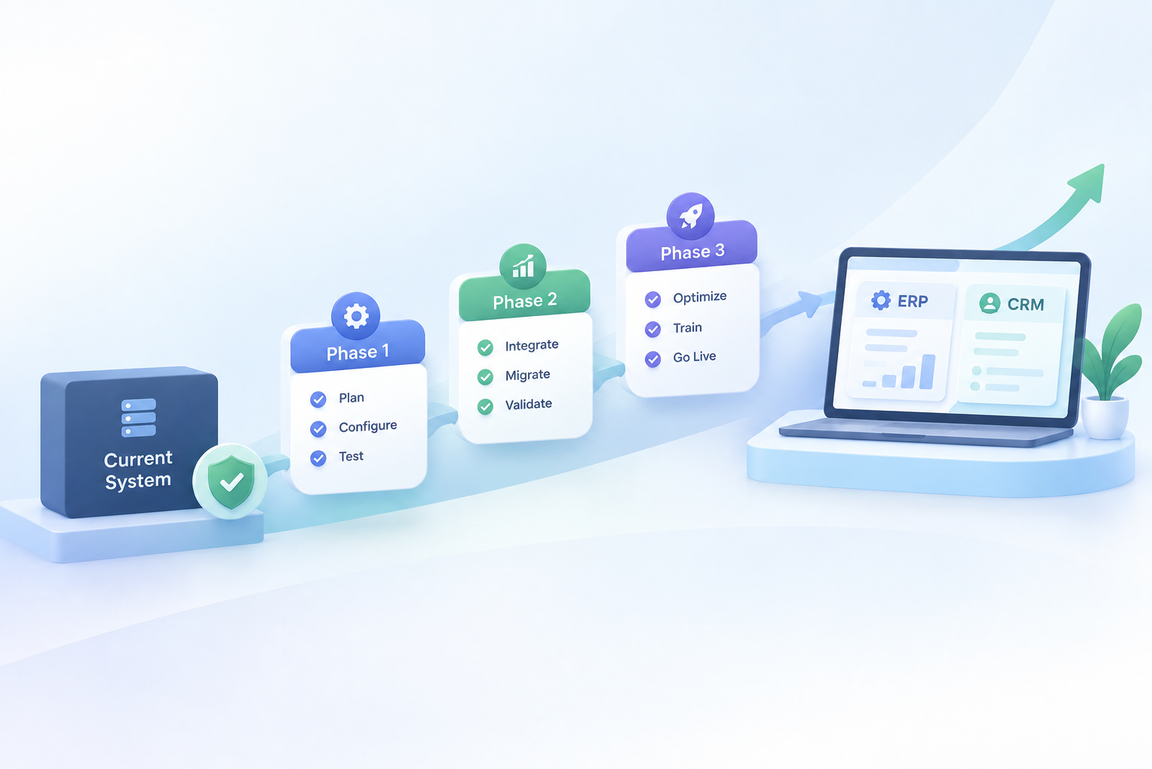
A common mistake is phasing by software module — “Phase 1: Finance module, Phase 2: HR module.” That’s an IT-centric view. We phase by business outcome instead. For a mid-sized insurance broking client, the phases looked like this:

  • Phase 1: Lead capture and policy renewal tracking for one regional branch (6 weeks)
  • Phase 2: Claims workflow integration with their TPA partners (8 weeks)
  • Phase 3: Commission reconciliation and agent payout automation (6 weeks)
  • Phase 4: Full rollout to remaining 14 branches (10 weeks)

Each phase delivered something the business could measure — fewer missed renewals, faster claims turnaround — instead of a vague “go-live” milestone that only IT cared about.

3. Pick a pilot group that represents real complexity, not the easiest one

There’s a temptation to pilot with your best-performing branch or your most tech-savvy team because things go smoothly. Resist it. We’ve seen clients pilot with an easy branch, declare success, then hit a wall in branch five because the pilot never tested exception scenarios — manual overrides, regulatory reporting formats specific to certain states, or legacy data with incomplete KYC fields. For a lending client, we deliberately piloted the new loan management system with their messiest branch — highest NPA ratio, most manual workarounds — specifically so the edge cases surfaced early.

4. Plan data migration as its own phase, with a freeze window

In BFSI, data migration isn’t a technical afterthought — it’s where audits go sideways. We always build in a dedicated reconciliation phase: migrate data, run the old and new systems in parallel for a defined window (typically 2-4 weeks depending on transaction volume), and reconcile every ledger entry before cutting over fully. For one fintech client handling merchant settlements, this parallel-run phase caught a mapping error in GST classification that would have caused incorrect invoicing for thousands of merchants if it had gone live directly.

5. Integrate compliance and audit checkpoints into every phase, not just at the end

It’s tempting to treat compliance sign-off as a final gate before go-live. In regulated environments, build your compliance and risk teams into each phase review instead. This means RBI reporting formats, data retention rules, or SEBI-related disclosures get validated incrementally, not discovered as a blocker right before launch.

6. Set a rollback plan before you need one

Every phase should have a clearly defined rollback point — what happens if phase 2 fails validation? For most of our implementations, we keep the legacy system live and read-accessible for at least one full business cycle after cutover, specifically so finance and compliance teams can cross-verify numbers without panic.

7. Measure adoption, not just deployment

A phase isn’t “done” when the software is switched on — it’s done when the people using it have stopped reverting to old habits. We track adoption metrics (login frequency, workflow completion rates, support ticket volume) for at least 30 days post go-live before calling a phase complete and moving to the next one.

The real takeaway

Phased implementation isn’t about being slow or cautious for its own sake — it’s about giving your business the ability to course-correct before a mistake becomes systemic. In BFSI and fintech, where errors touch regulatory compliance and customer money, that ability to pause, validate, and adjust between phases is what separates a smooth rollout from a six-month firefighting exercise.

If you’re evaluating an ERP or CRM overhaul and want a phasing plan built around your actual operational risk rather than a generic vendor playbook, that’s exactly the kind of conversation we have with clients at Speqto Technologies before a single line of configuration gets written.

RECENT POSTS

Reducing Loan Processing Time Through Workflow Automation: What Actually Works

If you’ve spent any time in lending operations, you already know the real cost of a slow loan cycle isn’t just customer frustration — it’s lost business. A borrower who waits 10 days for approval has usually applied with two other lenders in the meantime. We’ve seen this play out repeatedly with our BFSI clients […]

How to Plan a Phased ERP or CRM Implementation Without Breaking What Already Works

Every BFSI or fintech leader we’ve worked with has heard the same horror story at least once — a bank or NBFC switches on a new core system overnight, and for three weeks nobody can process loan disbursements properly. That’s the risk of a “big-bang” ERP or CRM rollout, and it’s exactly why phased implementation […]

Why Microservices Architecture Reduces Long-Term Maintenance Cost (A BFSI Perspective)

Every BFSI and fintech leader we’ve worked with at Speqto Technologies eventually asks us the same question: “Our monolith works fine today, so why should we spend money breaking it apart?” Fair question. The honest answer is — you shouldn’t do it for today. You do it for the three years after today, when your […]

Building Customer-Facing Portals for Financial Institutions: What Actually Works

Over the last few years, our team at Speqto Technologies has built portals for NBFCs, cooperative banks, insurance brokers, and a couple of wealth management firms. One thing that keeps surprising clients: the hardest part is rarely the UI. It’s getting core banking integrations, compliance workflows, and support escalation to work together without the whole […]

How AI Can Improve Fraud Detection in Banking Systems: What Actually Works

Most banks we talk to aren’t short on fraud rules. They have hundreds of them — thresholds on transaction amount, geography mismatches, velocity checks, blacklisted IFSC codes. The problem isn’t the lack of rules; it’s that fraudsters have learned to operate just below every threshold. That’s where AI earns its place, not as a buzzword, […]

POPULAR CATEGORIES