

Loading...

Building Multi-Region Deployment for Global Fintech Products: What Actually Breaks and How to Fix It

Building Multi-Region Deployment for Global Fintech Products: What Actually Breaks and How to Fix It

Most fintech founders start thinking about multi-region deployment for the wrong reason. They assume it’s about uptime — “what if our Mumbai data center goes down.” That’s part of it, sure. But if you’re building a payments or lending product that’s expanding beyond one country, the real driver is almost always compliance and latency, not disaster recovery.

We learned this the hard way while working with a cross-border payments client who went from serving India to onboarding merchants in the UAE and Singapore within eight months. Their engineering team had built a solid single-region setup on AWS Mumbai. It worked beautifully for Indian traffic. The moment UAE merchants started transacting, two things happened: transaction latency jumped to 400ms+ for API calls, and their compliance team flagged that customer PII couldn’t legally sit in an Indian data center under UAE’s data protection framework. That’s when “multi-region” stopped being a nice-to-have architecture diagram and became a hard business requirement with a deadline.

Start With the Regulation, Not the Architecture

Every BFSI decision-maker we’ve worked with wants to jump straight to “active-active vs active-passive.” Wrong starting point. Before touching infrastructure, map out where your data legally must live.

  • RBI mandates that payment system data for Indian transactions be stored only in India — this isn’t optional, and it applies even if your parent company is registered abroad.
  • GDPR doesn’t require EU data to stay in the EU, but it does require you to prove adequate protection if it leaves — which means contractual and technical controls, not just a server location.
  • UAE and Saudi Arabia are moving toward stricter local hosting requirements for financial data, especially after CBUAE’s recent guidelines on outsourcing and cloud usage.

This mapping exercise alone usually determines 70% of your regional architecture. In the client example above, it meant we couldn’t run a single global database with regional read replicas — we needed genuinely isolated data stores per region with a thin, non-PII layer for cross-region reporting.

Active-Active Sounds Great in Slide Decks, Rarely Survives Contact With Reality

Every CTO wants active-active — two or more regions serving live traffic simultaneously, both writable. It’s the gold standard for availability. It’s also brutally hard to get right for financial transactions where consistency isn’t optional.

The problem is conflict resolution. If a customer in Dubai and a fraud check triggered from Mumbai both try to update the same wallet balance within milliseconds, whose write wins? For inventory or content systems, eventual consistency is fine. For ledger entries, it isn’t. You end up needing either:

  • Region-sharded data ownership, where each customer’s data has one “home region” that owns writes, and other regions only read cached copies
  • A distributed consensus layer (like CockroachDB or Spanner-style systems) that adds real latency overhead per write, which you have to budget for

For most fintech products under, say, 5 million transactions a day, we push clients toward active-passive with regional data sharding rather than true active-active. It’s less impressive on paper, it’s dramatically easier to reason about during an incident at 2 AM, and it satisfies data residency requirements naturally since each region owns its own customers’ data.

The Failover Test Nobody Runs

Here’s an uncomfortable truth: most teams that claim to have multi-region DR have never actually failed over in production. They’ve tested it in staging, maybe once, eighteen months ago. Then the underlying infrastructure changes — a new microservice gets added, a database migration happens — and nobody updates the failover runbook.

We built a quarterly “failover fire drill” into our engagement with a lending platform client specifically because their board asked about RTO/RPO numbers during a funding round, and nobody on the engineering team could answer confidently. We now simulate a full region outage every quarter, measure actual recovery time, and feed the gaps back into the architecture. The first drill took 47 minutes to recover. After three quarters of fixes, it’s under 6 minutes.

Latency Is a Product Feature, Not Just an Infra Metric

For payment authorization flows, every 100ms of added latency has a measurable drop in conversion — this is well documented for e-commerce checkouts, and it’s just as true for UPI or card authorization screens. When you’re routing traffic across regions, be deliberate about which calls need to happen locally versus which can tolerate a round trip.

Practical approach: keep fraud scoring, authentication, and transaction authorization within the region closest to the user. Push reconciliation, reporting, and analytics workloads to a central region asynchronously. This split alone cut our fintech client’s average transaction latency from 400ms to under 120ms without touching their core banking integration.

Cost Conversations Decision-Makers Actually Care About

Multi-region isn’t cheap, and pretending otherwise doesn’t help anyone. Cross-region data transfer costs, duplicated infrastructure, and additional compliance auditing can add 30-40% to your infra bill. The way we frame it for BFSI clients is simple: price out the cost of a single regulatory fine or a data breach disclosure in a new market, and compare it against the infrastructure premium. It’s rarely a close call once it’s framed that way.

Where Speqto Fits In

We’ve built multi-region architectures for payments, lending, and wealth-tech platforms expanding across South Asia and the Middle East. The pattern that works isn’t the most sophisticated one — it’s the one your team can operate confidently during an actual incident, that satisfies your regulator’s specific requirements, and that you’ve genuinely tested, not just diagrammed. If you’re mapping out a multi-country expansion and the architecture conversation feels stuck at “which cloud region,” happy to compare notes on what’s actually worked for us.

RECENT POSTS

Building Multi-Region Deployment for Global Fintech Products: What Actually Breaks and How to Fix It

Most fintech founders start thinking about multi-region deployment for the wrong reason. They assume it’s about uptime — “what if our Mumbai data center goes down.” That’s part of it, sure. But if you’re building a payments or lending product that’s expanding beyond one country, the real driver is almost always compliance and latency, not […]


How Custom CRM Systems Improve Sales Team Productivity in BFSI and Fintech

Walk into any NBFC or insurance sales floor and you’ll see the same thing: relationship managers juggling three tools at once — a CRM that doesn’t talk to the loan origination system, WhatsApp for actual customer conversations, and an Excel sheet that “everyone updates” but nobody trusts. This isn’t a training problem. It’s a tooling […]

When Patchwork Fails: Signs Your BFSI Platform Needs a Rebuild, Not Another Patch

Every CTO we’ve worked with in banking and fintech has, at some point, defended an old system a little too long. It’s understandable — rebuilds are expensive, risky, and politically messy. Patching feels safer. But there’s a point where patching stops being a cost-saving move and starts becoming the thing that’s quietly bleeding your business […]

The $40,000 Handover: What Happens When Outsourced Projects Don’t Document Anything

A few years back, we picked up a project midway for a BFSI client — a mid-sized NBFC that had built a loan origination system with another vendor. The vendor was gone. The developers were gone. What remained was a working application, a production server, and absolutely nothing explaining how any of it fit together. […]

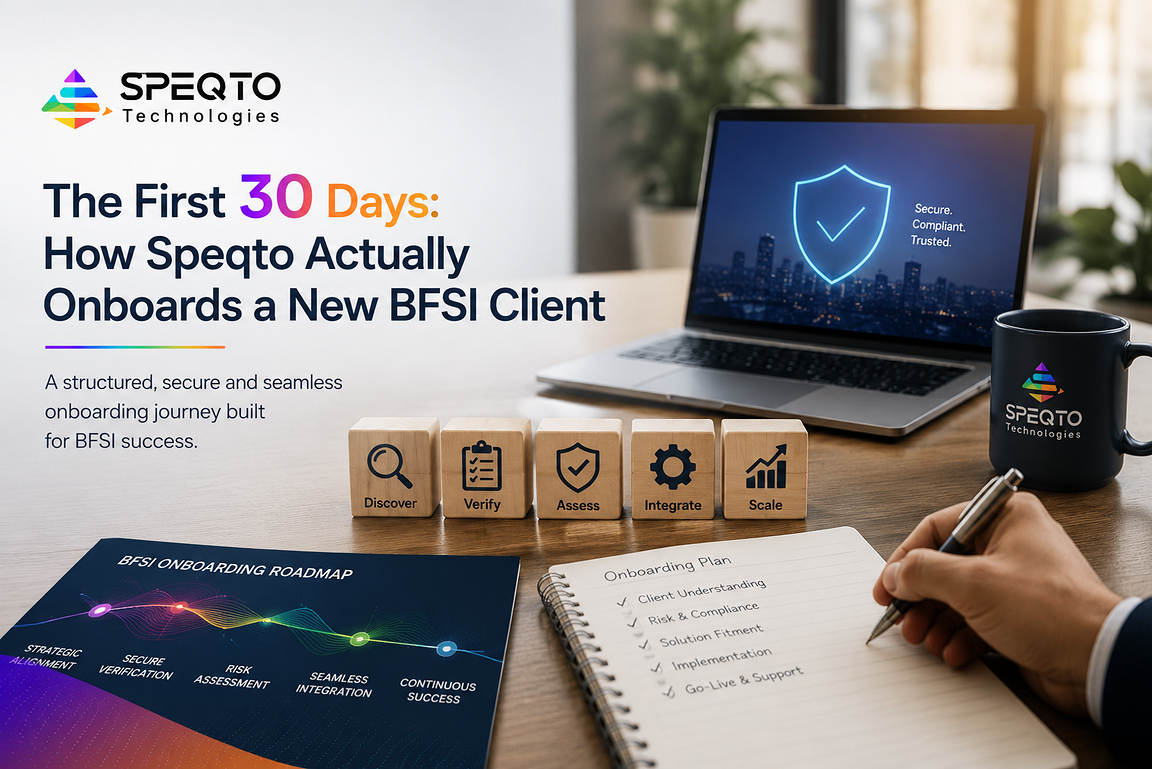
The First 30 Days: How Speqto Actually Onboards a New BFSI Client

Most agencies talk about “seamless onboarding” and then send you a generic questionnaire on day one. We’ve built our first 30 days differently, mostly because we learned the hard way what happens when you skip the boring parts on a fintech project. A couple of years ago, we started work with a Pune-based NBFC that […]

POPULAR CATEGORIES