
Loading...

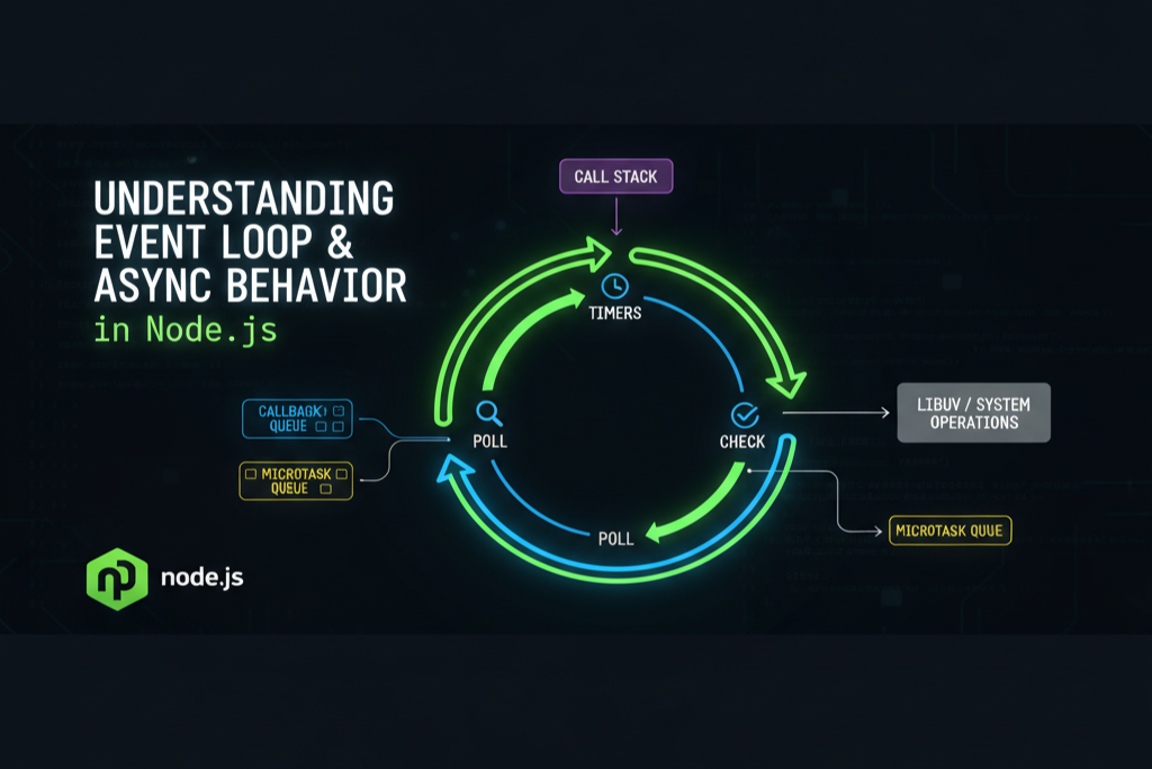
Understanding Event Loop & Async Behavior in Node.js

Divya Pal

26 September, 2025


Node.js is known for its speed and efficiency, but the real magic powering it is the Event Loop. Since Node.js runs on a single thread, understanding how the Event Loop manages asynchronous tasks is essential to writing performant applications. In this blog, we’ll explore how the Event Loop works, how async operations are handled, and why Node.js excels at non-blocking I/O.

What is the Event Loop?

The Event Loop is the core mechanism in Node.js that handles asynchronous operations. Although Node.js runs JavaScript in a single thread, it can still perform heavy I/O tasks without blocking the execution, thanks to the Event Loop and the underlying libuv library.

How the Event Loop Works

When Node.js receives asynchronous tasks — such as database queries, timers, or network calls — it delegates them to background threads managed by libuv. Once those operations are completed, callbacks are pushed back to the Event Loop for execution.

Phases of the Event Loop

The Event Loop cycles through multiple phases:

  • Timers: Executes callbacks from setTimeout and setInterval.
  • Pending Callbacks: Executes deferred I/O callbacks.
  • Idle & Prepare: Internal use only.
  • Poll: Retrieves new I/O events and executes I/O callbacks.
  • Check: Executes setImmediate callbacks.
  • Close Callbacks: Executes close event callbacks like socket.on('close').

Async Patterns in Node.js

1. Callbacks

Initially, async operations were handled with callbacks. While this worked, it often led to nested and hard-to-read code, known as callback hell.

2. Promises

Promises introduced a cleaner way to handle async flows using .then() and .catch(), reducing nested callbacks and improving readability.

3. Async/Await

Async/Await builds on top of promises and allows asynchronous code to be written like synchronous code. It’s now the most popular pattern in Node.js.

4. Event Emitters

EventEmitters allow multiple listeners to respond to events, making it ideal for real-time features like chat apps and notifications.

5. Streams

Streams process data in chunks, making them highly efficient for handling large files or continuous data flows.

Best Practices for Working with Async Code

1. Avoid Blocking the Event Loop

CPU-heavy computations should be moved to worker threads. Blocking the Event Loop reduces performance and scalability.

2. Use Promise.all for Parallel Async Tasks

If tasks are independent, run them in parallel to reduce execution time.

3. Always Handle Errors

Use try/catch with async/await or .catch() with promises to prevent crashes.

4. Utilize Performance Tools

Tools like clinic.js, pm2, and Node.js inspector help analyze and optimize performance.

Conclusion

Understanding the Event Loop is essential for mastering Node.js performance. By leveraging async patterns correctly and avoiding blocking operations, you can build scalable, fast, and efficient applications. The better you understand how Node.js handles async tasks, the more powerful your applications will become.

RECENT POSTS

Socket.IO Security Unveiled: Mastering Authentication & Authorization for Robust Real-time Applications

Socket.IO Security Unveiled: Mastering Authentication & Authorization for Robust Real-time Applications Divya Pal 4 February, 2026 In the dynamic landscape of modern web development, real-time applications have become indispensable, powering everything from chat platforms to collaborative editing tools. At the heart of many of these interactive experiences lies Socket.IO, a powerful library enabling low-latency, bidirectional […]

Prisma ORM in Production: Architecting for Elite Performance and Seamless Scalability

Prisma ORM in Production: Architecting for Elite Performance and Seamless Scalability Shubham Anand 16 February 2026 In the rapidly evolving landscape of web development, database interaction stands as a critical pillar. For many modern applications, Prisma ORM has emerged as a powerful, type-safe, and intuitive tool for interacting with databases. However, transitioning from development to […]

Streamlining DevOps: The Essential Guide to Gatling Integration in Your CI/CD Pipeline

Streamlining DevOps: The Essential Guide to Gatling Integration in Your CI/CD Pipeline Megha Srivastava 04 February 2026 In the dynamic landscape of modern software development, the quest for efficiency and reliability is paramount. DevOps practices have emerged as the cornerstone for achieving these goals, fostering seamless collaboration and rapid delivery. Yet, even the most robust […]

Fortifying Your Enterprise: Playwright Best Practices for Unbreakable Test Resilience

Fortifying Your Enterprise: Playwright Best Practices for Unbreakable Test Resilience Megha Srivastava 04 February 2026 In the dynamic landscape of enterprise software development, the quest for robust, reliable, and efficient testing is paramount. As systems grow in complexity, the challenge of maintaining an ironclad testing suite that withstands constant evolution becomes a critical differentiator. This […]

The TanStack Query Revolution: Elevating Your Data Fetching Paradigm from Basic to Brilliant

The TanStack Query Revolution: Elevating Your Data Fetching Paradigm from Basic to Brilliant GAURAV GARG 04 February 2026 In the dynamic landscape of web development, managing server state and data fetching often presents a labyrinth of challenges. From stale data and intricate caching mechanisms to race conditions and manual error handling, developers frequently grapple with […]

POPULAR CATEGORIES