
Loading...

REST vs GraphQL vs tRPC: Performance, Caching, and DX Compared with Real-World Scenarios

Shubham Anand

29-Oct-2025

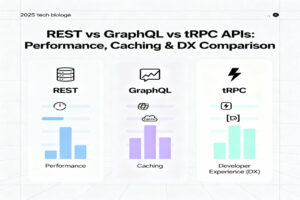
API architecture selection—REST, GraphQL, and tRPC—directly impacts an application’s performance, caching, and developer experience (DX). In 2025, understanding how each performs in real-world scenarios is critical for teams seeking the right balance between reliability and agility.

1. REST: The Reliable Veteran

    • Performance: Built on HTTP standards, REST remains fast for basic CRUD and resource-driven APIs. However, over-fetching and under-fetching can slow down complex queries.
    • Caching: Excels with mature HTTP caching mechanisms supported natively by proxies and browsers.
    • Developer Experience: Familiar, language-agnostic, and easy to debug. But scaling advanced UIs or joining multiple resources can create boilerplate and inefficiency.
    • Real-world use: E-commerce catalogs, industry-standard public APIs, simple mobile backends.

2. GraphQL: The Flexible Powerhouse

  • Performance: Allows clients to request only what they need, reducing over-fetching. However, may introduce performance hits for simple fetches due to parsing and resolver depth (e.g., 1864ms avg. latency vs 923ms for REST on simple queries, but excels in complex data fetching).
  • Caching: HTTP caching is non-trivial, but clients can use advanced client-side normalized caches or persistent queries for speed.
  • Developer Experience: Strongly typed schemas; boosts productivity (62% of teams report increased DX). Great for frontends and evolving UI needs, but can be overkill for simple data needs.
  • Real-world use: Social media feeds, dashboards aggregating many sources, mobile and SPA UIs for rich data presentation.

3. tRPC: The TypeScript Specialist

  • Performance: Minimal overhead, highly performant with binary and multiplexed transport (HTTP/2), and leverages end-to-end type safety for faster development. Typically matches or beats REST and GraphQL in Node/TypeScript apps.
  • Caching: Relies on custom strategies, such as HTTP cache headers or client-side solutions; less out-of-the-box support than REST, more flexibility for tailored needs.
  • Developer Experience: Automatic type safety from client to server with zero codegen. Minimal boilerplate, instant feedback, and ideal for TypeScript monorepos. Not suitable for polyglot or public APIs.
  • Real-world use: Internal admin panels, rapid prototyping, modern TypeScript SaaS dashboards, modular architectures with fast inter-service communication.

4. Scenario-Based Comparison

  • Public API for Third-Party Devs: REST provides simplicity and broad compatibility. Caching and documentation are straightforward. GraphQL can be added for advanced clients.
  • Complex Enterprise Dashboard: GraphQL shines when aggregating multiple sources and delivering nested, precise data for UIs. Caching and performance require planning but front-end teams thrive.
  • Internal Tools/Monorepos: tRPC offers unmatched type safety, rapid iteration, and minimal overhead, ideal for TypeScript-first teams and tight client-server coupling.

5. Summary Table

Feature REST GraphQL tRPC
Performance Fast (esp. simple CRUD) Best for complex data, may lag for simple fetches Fastest for TS monorepos, minimal overhead
Caching Native HTTP caching Advanced client-side caching Custom/Client-side
Type Safety Manual/Optional Schema-based, not end-to-end Automatic (TypeScript-first)
DX (Developer Experience) Simple, language-agnostic Schema-driven, productive in rich UIs Zero-boilerplate, instant TS types
Best Use Case Public APIs, CRUD Complex, aggregative UIs Internal tools, TS stacks

Conclusion

In practice, there’s no single winner—REST, GraphQL, and tRPC each excel under different circumstances. REST’s simplicity makes it great for public APIs; GraphQL empowers rich, flexible frontends; tRPC accelerates internal apps in TypeScript ecosystems. The technical and business needs of your project should drive your API architecture decision.

RECENT POSTS

Beyond the Battlefield: Architecting Your Web App with Optimal SSR or CSR Rendering

Beyond the Battlefield: Architecting Your Web App with Optimal SSR or CSR Rendering Gaurav Garg 06 March 2026 In the dynamic landscape of web development, a fundamental architectural decision often dictates the success and user experience of a web application: the choice between Server-Side Rendering (SSR) and Client-Side Rendering (CSR). This isn’t merely a technical […]

How IT Companies Can Win Global Clients in 2026

How IT Companies Can Win Global Clients in 2026   Chirag Verma 06/03/2026 In 2026, the global technology market is more competitive and opportunity-rich than ever before. Businesses across industries are searching for reliable IT partners who can help them innovate, scale, and stay ahead in an increasingly digital world. For IT companies, winning global […]

The Human Side of AI: How HR Leaders Will Shape the Future of Work in 2026

The Human Side of AI: How HR Leaders Will Shape the Future of Work in 2026 Khushi Kaushik 06 march, 2026 Introduction As we step into 2026, the workplace is evolving faster than ever before. Artificial Intelligence, automation, remote work, and digital collaboration tools are transforming how organizations operate. But amid all this innovation, one […]

Socket.IO Security Unveiled: Mastering Authentication & Authorization for Robust Real-time Applications

Socket.IO Security Unveiled: Mastering Authentication & Authorization for Robust Real-time Applications Divya Pal 4 February, 2026 In the dynamic landscape of modern web development, real-time applications have become indispensable, powering everything from chat platforms to collaborative editing tools. At the heart of many of these interactive experiences lies Socket.IO, a powerful library enabling low-latency, bidirectional […]

Prisma ORM in Production: Architecting for Elite Performance and Seamless Scalability

Prisma ORM in Production: Architecting for Elite Performance and Seamless Scalability Shubham Anand 16 February 2026 In the rapidly evolving landscape of web development, database interaction stands as a critical pillar. For many modern applications, Prisma ORM has emerged as a powerful, type-safe, and intuitive tool for interacting with databases. However, transitioning from development to […]

POPULAR CATEGORIES