
Loading...

Warning: Undefined array key "post_id" in /home/u795416191/domains/speqto.com/public_html/wp-content/themes/specto-fresh/single.php on line 22

Learn how to build a fully automated CI/CD pipeline on AWS ECS using GitHub Actions. Discover tips, best practices, and strategies to deploy faster, safer, and smarter.

Author: Charu Rajput
Date: 29 Sep 2025

Introduction:

Picture this: your team pushes a new feature, and within minutes, it’s live in production without downtime or manual intervention. Sounds like a dream? That’s the power of CI/CD pipelines combined with AWS ECS.

Continuous Integration and Continuous Deployment aren’t just buzzwords they are the lifeline of modern DevOps teams. With containers becoming the standard for applications, ECS (Elastic Container Service) provides a scalable and reliable platform, while GitHub Actions automates the pipeline from code commit to deployment.

In this blog, we’ll explore how to make this dream setup a reality, while following production-ready best practices.

1. Start With Containers: The Heart of Modern Deployments

Containers are the building blocks of cloud-native applications. They ensure your app runs the same way on your laptop, in staging, and in production. Docker is the de-facto choice for containerizing applications.

Tip: Always keep your Docker images lightweight and secure. Every MB counts when scaling in ECS.

2. Pushing to AWS ECR: Your App’s Launchpad

Amazon ECR (Elastic Container Registry) is like a private app store for your Docker images. Once your image is in ECR, ECS can pull it automatically.

Think of it like this:

Your Code → Container → Registry → Deployment

Automating this chain reduces human error and accelerates release cycles.

3. ECS: Scaling Made Simple

AWS ECS allows your application to scale automatically based on demand. Whether it’s 10 users or 10,000, ECS keeps your app running smoothly. Pair it with Fargate, and you don’t even need to manage servers just focus on your code.

Tip: Use task definitions and services wisely. They define how your containers run and communicate, ensuring stability in production.

4. GitHub Actions: The Glue of Automation

GitHub Actions is like a supercharged assistant: it watches your code, builds containers, runs tests, and pushes updates all automatically.

Why GitHub Actions Rocks:

  • No extra CI server setup required.

  • Fully integrated with your GitHub repository.

  • Supports Docker, Kubernetes, ECS, and more.

5. Making the Pipeline Production-Ready

Here’s how to make your CI/CD pipeline reliable, fast, and safe:

  • Versioned Docker Images: Avoid latest in production; use commit SHA or tags.

  • Automated Testing: Run unit, integration, and E2E tests before deployment.

  • Blue/Green or Canary Deployments: Reduce risk with gradual rollouts.

  • Monitoring & Alerts: Integrate CloudWatch, Prometheus, or Grafana for proactive detection.

  • Secrets Management: Never hardcode credentials; use AWS Secrets Manager or GitHub Secrets.

6. Benefits You’ll See Immediately

Implementing this pipeline will:

  • Cut manual deployment time from hours to minutes.

  • Reduce human error, preventing broken releases.

  • Enable faster feedback on new features.

  • Scale seamlessly with your business needs.

Imagine merging a feature branch and watching it automatically appear in production within minutes. That’s the DevOps dream in action!

7. Visuals to Enhance Understanding

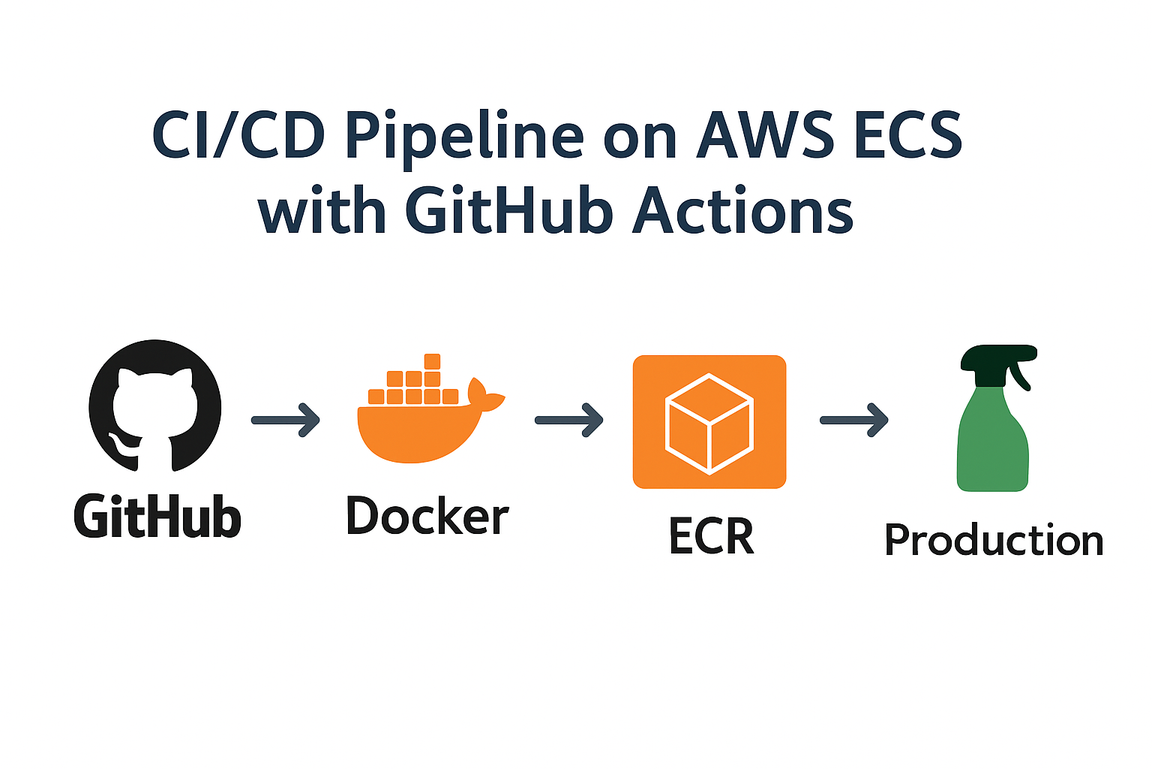
1. CI/CD Pipeline Flow:
Shows how code goes from GitHub → Docker → ECR → ECS → Production.

2. Blue/Green Deployment:
Illustrates safe deployment with minimal downtime and easy rollback.

3. Auto-Scaling Diagram:
Shows how ECS automatically scales tasks based on load.

4. Monitoring & Alerts:
Demonstrates metrics collection and alerting for proactive incident management.

Conclusion: From Chaos to Confidence

A CI/CD pipeline on AWS ECS with GitHub Actions isn’t just a technical setup it’s a mindset. It transforms how teams release software, allowing them to focus on building value instead of babysitting deployments.

With automation, version control, monitoring, and best practices in place, your team can deploy faster, safer, and with confidence.

RECENT POSTS

Beyond the Battlefield: Architecting Your Web App with Optimal SSR or CSR Rendering

Beyond the Battlefield: Architecting Your Web App with Optimal SSR or CSR Rendering Gaurav Garg 06 March 2026 In the dynamic landscape of web development, a fundamental architectural decision often dictates the success and user experience of a web application: the choice between Server-Side Rendering (SSR) and Client-Side Rendering (CSR). This isn’t merely a technical […]

How IT Companies Can Win Global Clients in 2026

How IT Companies Can Win Global Clients in 2026   Chirag Verma 06/03/2026 In 2026, the global technology market is more competitive and opportunity-rich than ever before. Businesses across industries are searching for reliable IT partners who can help them innovate, scale, and stay ahead in an increasingly digital world. For IT companies, winning global […]

The Human Side of AI: How HR Leaders Will Shape the Future of Work in 2026

The Human Side of AI: How HR Leaders Will Shape the Future of Work in 2026 Khushi Kaushik 06 march, 2026 Introduction As we step into 2026, the workplace is evolving faster than ever before. Artificial Intelligence, automation, remote work, and digital collaboration tools are transforming how organizations operate. But amid all this innovation, one […]

Socket.IO Security Unveiled: Mastering Authentication & Authorization for Robust Real-time Applications

Socket.IO Security Unveiled: Mastering Authentication & Authorization for Robust Real-time Applications Divya Pal 4 February, 2026 In the dynamic landscape of modern web development, real-time applications have become indispensable, powering everything from chat platforms to collaborative editing tools. At the heart of many of these interactive experiences lies Socket.IO, a powerful library enabling low-latency, bidirectional […]

Prisma ORM in Production: Architecting for Elite Performance and Seamless Scalability

Prisma ORM in Production: Architecting for Elite Performance and Seamless Scalability Shubham Anand 16 February 2026 In the rapidly evolving landscape of web development, database interaction stands as a critical pillar. For many modern applications, Prisma ORM has emerged as a powerful, type-safe, and intuitive tool for interacting with databases. However, transitioning from development to […]

POPULAR TAG

POPULAR CATEGORIES