

Loading...

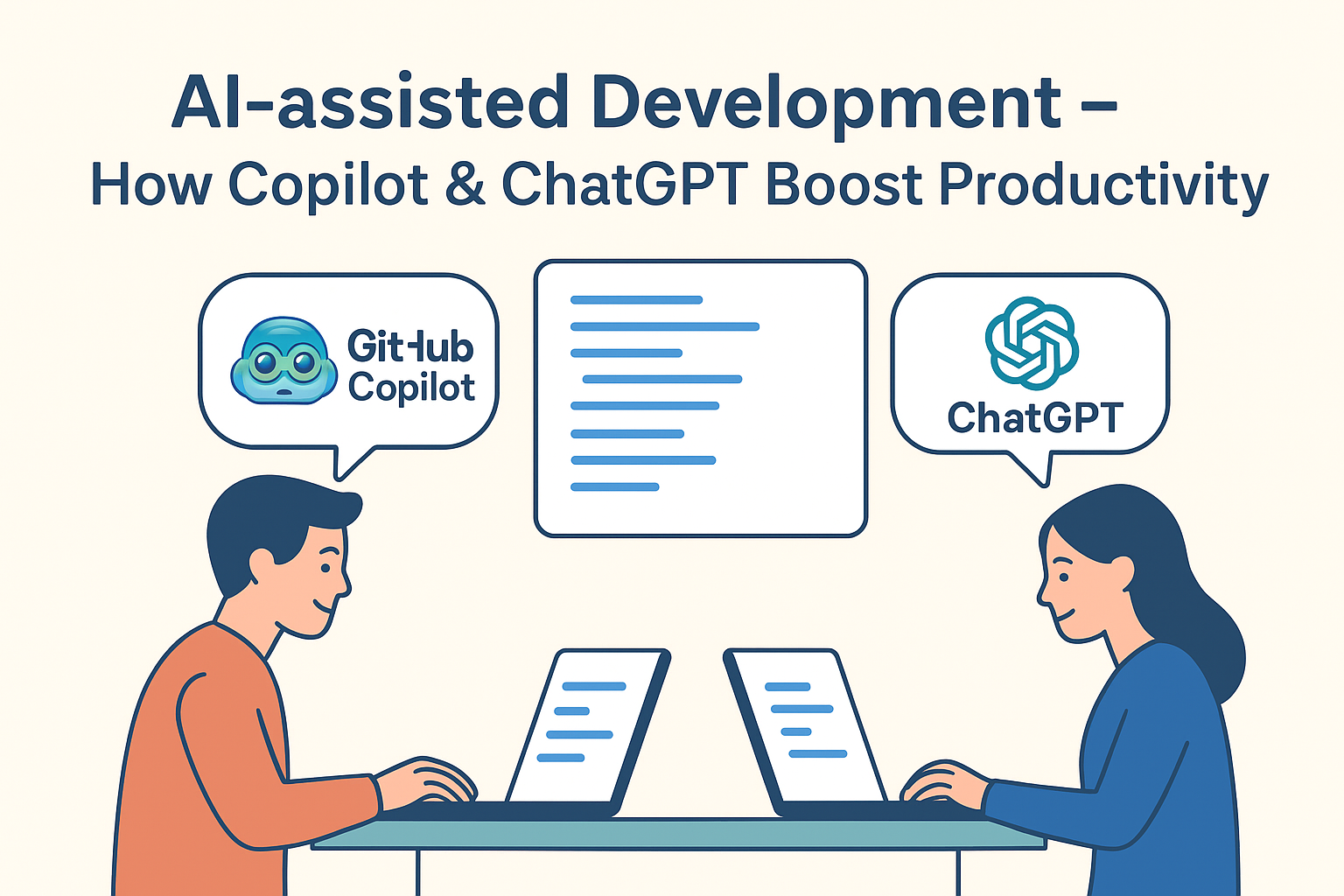
AI-assisted Development – How Copilot & ChatGPT Boost Productivity

AI-assisted Development – How Copilot & ChatGPT Boost Productivity

Shubham Anand

26-Aug-2025

In the fast-paced world of software engineering, developers are constantly under pressure to deliver high-quality applications faster. This is where AI-assisted development has become a game changer. With tools like GitHub Copilot and ChatGPT, developers can code smarter, reduce repetitive tasks, and focus more on problem-solving rather than boilerplate coding. But how exactly do these tools fit into modern workflows, and are they truly the future of programming?

1. Problem Statement

  • Developers spend a large portion of their time writing repetitive code instead of solving core business problems.
  • Context switching between coding, documentation, and debugging slows productivity.
  • Knowledge gaps in new frameworks and languages can delay project delivery.

2. Approach to Resolve

  • Use AI pair programming tools like GitHub Copilot to autocomplete functions, suggest optimizations, and reduce repetitive coding effort.
  • Leverage ChatGPT for natural language problem-solving—explaining errors, generating test cases, and documenting workflows.
  • Integrate AI assistants into IDEs (VS Code, JetBrains) to keep development seamless and contextual.

3. Tools & Techniques to Follow

  • GitHub Copilot: Real-time code suggestions powered by OpenAI Codex.
  • ChatGPT: Debugging support, architecture planning, and generating learning resources.
  • Tabnine & CodeWhisperer: Alternatives for AI code completion across multiple languages.
  • AI-based Testing Tools: Generate unit tests and API mocks automatically.
  • Integration: Plugins for IDEs and CI/CD pipelines ensure AI is part of the developer’s daily workflow.

4. Tips to Enhance Developer Experience

  • Don’t blindly copy suggestions—always validate AI-generated code for security and performance.
  • Use AI as a teaching assistant when exploring new frameworks or languages.
  • Balance between automation and creativity—AI handles repetitive work, while developers focus on innovation.
  • Encourage collaborative workflows where teams use AI tools but also review and refine outputs together.
  • Track productivity gains with metrics like reduced bug counts and faster delivery cycles.

5. Real-World Examples

  • At Microsoft, developers use Copilot across Visual Studio Code to speed up repetitive tasks like API integrations.
  • Startups adopt ChatGPT for quickly generating documentation, FAQs, and onboarding materials for new developers.
  • E-commerce teams rely on AI to build automated test cases and validate UI workflows before launch.
  • In Speqto’s internal projects, developers experiment with AI-powered suggestions to prototype features faster while maintaining quality checks manually.

Conclusion

AI-assisted development is not about replacing developers—it’s about augmenting their capabilities. By reducing repetitive coding, offering real-time help, and providing intelligent insights, tools like Copilot and ChatGPT empower engineers to work smarter and faster. In 2025, development teams that embrace AI in their workflow will see:

  • Increased productivity with reduced development cycles.
  • Higher code quality thanks to AI-assisted debugging and documentation.
  • Better developer satisfaction due to reduced cognitive load.

The future of coding is collaborative—not just between humans, but between humans and AI. Teams that learn to pair with AI effectively will unlock faster delivery, innovation, and growth in the ever-evolving digital world.

RECENT POSTS

Choosing a Tech Partner Who Actually Understands Regulatory Compliance

A few months back, a fintech client came to us after a failed product launch. Their previous development partner had built a solid lending app — clean UI, fast performance, good UX. The problem? Nobody on that team had accounted for RBI’s Digital Lending Guidelines around data storage and third-party data sharing. The app went […]


How Automation Reduces Manual Errors in Banking Back-Office Work

A few months ago, we sat down with the operations head of a mid-sized NBFC who told us something that stuck with us: “My team isn’t lazy or careless. They’re just human, and humans reconciling 40,000 transactions a day will always slip somewhere.” That one sentence sums up why banking back offices keep bleeding money […]

Building Dashboards for Real-Time Transaction Monitoring: What Actually Works in BFSI

A few months back, one of our fintech clients — a Mumbai-based NBFC processing close to 40,000 UPI and card transactions a day — came to us with a problem that sounded simple on the surface: “Our fraud team is looking at data that’s 15 minutes old, and by the time they act, the money’s […]

Why a Dedicated PM Matters in Outsourced Software Projects (Especially for BFSI Teams)

A few months ago, a fintech client came to us at Speqto Technologies after a rough experience with a previous outsourcing vendor. The code wasn’t the problem — their developers were competent. The problem was that nobody owned the project end to end. Requirements got lost in Slack threads, QA found bugs three sprints too […]

What Startup India and MeitY Recognition Actually Means When You’re Evaluating a Tech Vendor

If you’re on the vendor onboarding side of a bank, NBFC, or fintech company, you’ve seen this drill a hundred times. A vendor sends over a slick deck, promises the moon on integration timelines, and then your compliance team spends three weeks trying to figure out if this company even legally exists in a form […]

POPULAR TAG

POPULAR CATEGORIES