
Loading...

The Gatekeeper’s Fallacy: Why the “End-of-Line” QA Model is Obsolete

Megha Srivastava

24 October 2025

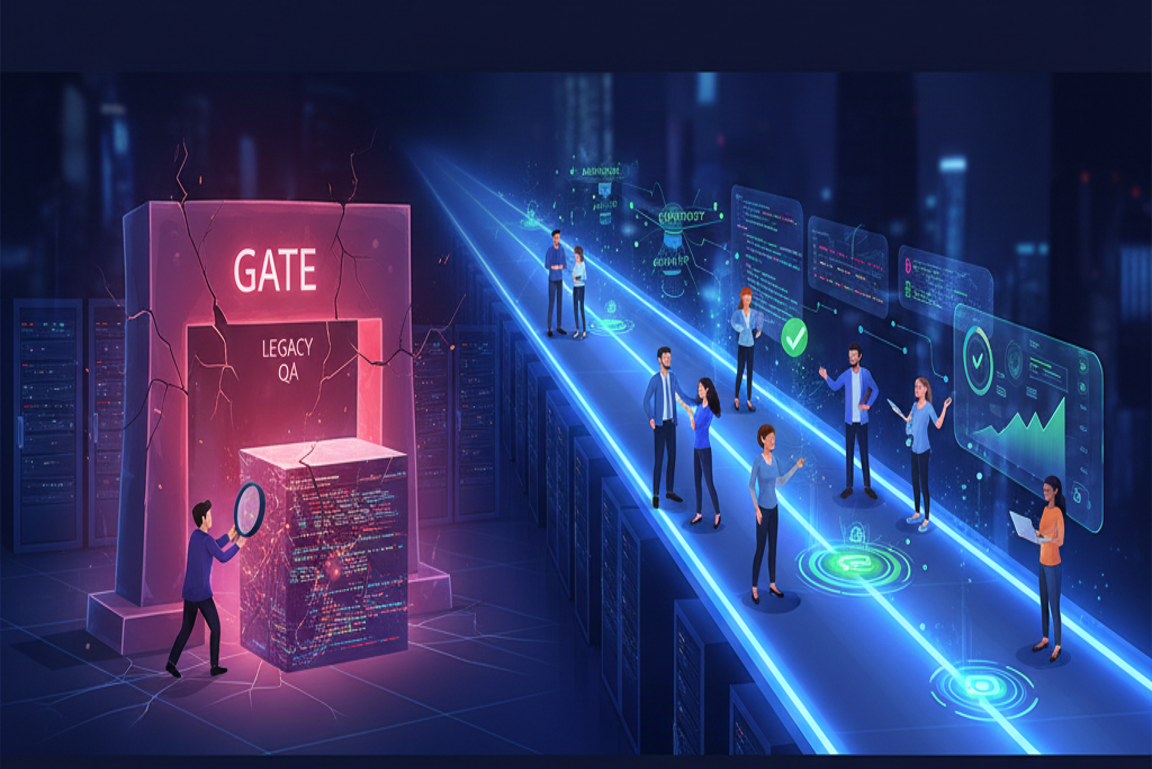
A modern, continuous QA pipeline replacing an old-fashioned gatekeeper

For decades, the software development world operated on a simple, linear model. Developers would build, and when they were “done,” they would “throw the code over the wall” to the Quality Assurance (QA) team. This team acted as a final gatekeeper, a barrier responsible for catching every bug before a release could go to customers. This model felt safe, logical, and necessary.

This model is now a fallacy. In the modern era of CI/CD, microservices, and rapid, continuous deployment, the “end-of-line” gatekeeper model is not just inefficient—it’s obsolete. It creates bottlenecks, fosters a divisive culture, and ultimately fails to deliver true quality. True quality isn’t found at the end; it’s engineered from the beginning. This article explores why the gatekeeper fallacy is holding your team back and outlines the new, integrated philosophy that replaces it.

The Cracks in the Gate: Where the Old Model Fails

The gatekeeper model is a relic of a time when software was shipped in boxes once a year. Today, it collapses under the pressure of modern development speeds for several key reasons.

1. The Bottleneck Effect

When all testing is back-loaded, QA becomes a single point of failure. Features from multiple developers or teams pile up, all waiting to get through the same narrow gate. This creates a massive traffic jam. Developers are idle waiting for feedback, release schedules slip, and the pressure mounts on the QA team to “test faster,” often forcing them to cut corners—the exact opposite of their intended purpose.

2. The High Cost of Late Detection

A bug found by a QA tester just before release is exponentially more expensive to fix than one found by a developer during coding. Fixing a late-stage bug requires a developer to stop their current work, context-switch back to old code, identify the root cause, write a fix, and then resubmit the *entire* feature for re-testing. This context switching is a massive drain on productivity. Finding that same bug in the design or unit-testing phase is nearly free by comparison.

3. The “Us vs. Them” Culture

The gatekeeper model inherently creates friction. It pits “developers” (who build) against “testers” (who break). Developers see QA as a barrier to shipping, and QA feels the pressure of being the sole person responsible for quality. This “us vs. them” mindset is toxic and directly conflicts with the collaborative, shared-responsibility principles of modern DevOps and Agile methodologies.

From Gatekeeper to Quality Engineer: The New Philosophy

The future of QA isn’t about *finding* bugs; it’s about *preventing* them. This requires a fundamental shift in mindset, where quality is no longer a “phase” but a shared responsibility woven into the entire software development lifecycle (SDLC). The QA professional evolves from a “tester” to a “Quality Engineer” (QE).

In this new model, the QE’s job is not to manually test everything. Their job is to build a “quality pipeline”—to provide the tools, processes, and automation that empower developers to test their own code effectively and continuously.

Shift-Left: Integrating Quality at the Source

“Shift-Left” means moving quality activities to the earliest possible point in the process. A QE is involved in design and requirements-planning sessions, asking “how will we test this?” before a single line of code is written. They help developers write better unit and integration tests and build automated checks that run every time code is committed.

Shift-Right: Learning from Production

This futuristic concept acknowledges that no amount of pre-release testing can replicate the chaos of a live production environment. “Shift-Right” involves using techniques like feature flags, canary releases, and robust observability (monitoring, logging) to test new features safely in production with real users. Quality becomes a continuous feedback loop from live data, not a one-time approval.

Automation as the Default

In the old model, automation was a “nice-to-have.” In the new model, it’s the foundation. Quality Engineers build and maintain automation frameworks that check the code at every stage of the CI/CD pipeline. This frees up human testers to focus on high-value tasks like exploratory testing, usability testing, and security analysis—things machines can’t do.

Instead of a manual test plan, quality becomes part of the code, often in a CI/CD pipeline configuration file:


jobs:
  test:
    name: Run Quality Checks
    runs-on: ubuntu-latest
    steps:
      - name: Run Static Analysis (Lint)
        run: lint_check .
      - name: Run Unit Tests
        run: pytest --cov
      - name: Build & Deploy to Staging
        run: ./deploy_staging.sh
      - name: Run E2E Smoke Tests on Staging
        run: cypress run --spec 'tests/smoke.js'

New Metrics for a New Model

The gatekeeper model’s primary metric was “number of bugs found.” This is a vanity metric that encourages finding bugs, not preventing them. The new model focuses on business-level metrics that measure speed and stability:

Cycle Time: How long does it take from an idea to deployed code in production? An integrated quality process *dramatically* shortens this.
Change Fail Percentage: What percentage of your deployments to production cause a failure?
Mean Time to Recovery (MTTR): When a bug *does* make it to production, how quickly can you fix it? A good pipeline makes this minutes, not days.

Conclusion: Quality is an Engineered Feature, Not a Final Step

The “Gatekeeper’s Fallacy” is the belief that you can “add quality” at the end of a process. You can’t. Quality is like security or performance—it must be designed and built in from the very beginning. By dismantling the old-fashioned gate and embedding quality engineers within development teams, you break down silos, eliminate bottlenecks, and build a culture of shared ownership.

In this new world, quality is no longer a department that says “no.” It’s an engineering discipline that enables the entire organization to move faster, with more confidence.

Frequently Asked Questions

Q: Does this mean we don’t need QA testers anymore?
A: No, it means the role has evolved. We need fewer manual “bug finders” and more “Quality Engineers”—people who can code, automate, think about system architecture, and act as quality coaches for the entire team.

Q: What’s the first step to move away from the gatekeeper model?
A: Start small. Embed one QA professional into one development team. Make their goal to help that team automate its regression tests and participate in code reviews. The cultural shift will begin to spread from that one “seed” team.

Q: Isn’t testing in production (“Shift-Right”) risky?
A: It’s done safely using modern deployment techniques. With feature flags, you can release a feature “off” by default, then turn it on for just the internal team, then 1% of users, then 10%, etc. This allows you to monitor for errors in a controlled way with real users, providing far more confidence than any staging environment ever could.

Related Resources

Explore our guides on What is Test Observability? and The Rise of the Quality Engineer to enhance your QA strategy.

Ready to modernize your quality process? Partner with Speqto’s Quality Engineering experts to build an integrated, automated quality strategy that accelerates your business.

RECENT POSTS

From First Call to Project Launch — A BD’s Guide to Seamless Client Onboarding

From First Call to Project Launch — A BD’s Guide to Seamless Client Onboarding Chirag Verma 29/10/2025 In the IT industry, a client’s first impression can define the entire relationship. From the very first call to the moment a project officially begins, every step of the onboarding journey shapes how the client perceives your company’s […]

Understanding Event Loop & Async Behavior in Node.js

Understanding Event Loop & Async Behavior in Node.js Divya Pal 26 September, 2025 Node.js is known for its speed and efficiency, but the real magic powering it is the Event Loop. Since Node.js runs on a single thread, understanding how the Event Loop manages asynchronous tasks is essential to writing performant applications. In this blog, […]

REST vs GraphQL vs tRPC: Performance, Caching, and DX Compared with Real-World Scenarios

REST vs GraphQL vs tRPC: Performance, Caching, and DX Compared with Real-World Scenarios Shubham Anand 29-Oct-2025 API architecture selection—REST, GraphQL, and tRPC—directly impacts an application’s performance, caching, and developer experience (DX). In 2025, understanding how each performs in real-world scenarios is critical for teams seeking the right balance between reliability and agility. 1. REST: The […]

Collaborating in a Multi-Disciplinary Tech Team: Frontend and Beyond

Collaborating in a Multi-Disciplinary Tech Team: Frontend and Beyond Gaurav Garg 28-10-2025 Cross-functional collaboration is a force multiplier for product velocity and quality when teams align on shared goals, clear interfaces, and feedback loops across design, frontend, backend, DevOps, data, and QA. High-performing teams in 2025 emphasize structured rituals, shared artifacts (design systems, API contracts), […]

The Role of a BDE in Helping Businesses Modernize with Technology

The Role of a BDE in Helping Businesses Modernize with Technology Karan Kumar 28/10/2025 At Speqto Technologies, we’ve witnessed firsthand how technology has become the foundation of business success in 2025. But adopting new technologies isn’t just about staying trendy it’s about staying relevant, competitive, and efficient. That’s where a Business Development Executive (BDE) plays […]

POPULAR TAG

POPULAR CATEGORIES