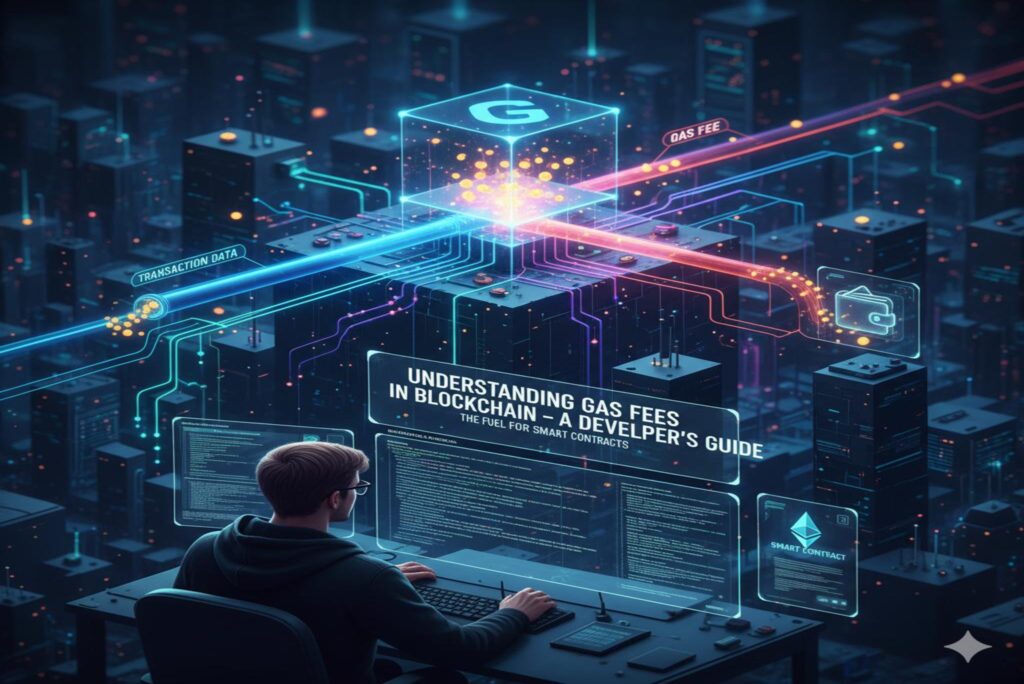
Understanding Gas Fees in Blockchain – A Developer’s Guide

If you’ve ever sent a crypto transaction, you’ve probably noticed something called a “gas fee.” Whether you’re building a DApp or simply trading tokens, understanding gas fees is essential. In this guide, we’ll break down what gas fees are, how they work, and how developers can optimize them for a better user experience.
What Are Gas Fees?
Gas fees are the transaction costs users pay to use blockchain networks like Ethereum, Polygon, or BNB Chain. They compensate miners (or validators) for validating and executing transactions. In simple terms — gas keeps the blockchain running.
How Gas Works
Every operation on the blockchain — from transferring tokens to deploying a smart contract — requires computational power. This power is measured in gas units.
You also pay a gas price, typically in the network’s native token (like ETH).
The total fee = Gas Used × Gas Price.
For example:
If a transaction uses 21,000 gas
and the gas price is 20 gwei,
then total fee = 21,000 × 20 gwei = 0.00042 ETH
Gas in EVM-based Chains
On Ethereum and other EVM-compatible chains, the gas fee system ensures that:
- Smart contracts don’t run indefinitely (prevents infinite loops)
- Network congestion is managed efficiently
- Validators are incentivized to include transactions
Tips for Developers to Optimize Gas
1. Use Efficient Data Types
Choose smaller data types (like uint8 instead of uint256 when possible). Each byte saved reduces gas usage.
2. Minimize Storage Operations
Storage is the most expensive part of a smart contract. Reuse variables and avoid unnecessary writes to the blockchain.
3. Batch Transactions
Instead of executing multiple single transactions, batch them in one function call when possible. It’s cheaper and faster for users.
4. Use Layer 2 Solutions
For cost-effective scaling, integrate with Layer 2 chains like Arbitrum, Optimism, or Base. These networks significantly reduce gas fees while maintaining Ethereum security.
Gas Fee Variations Across Networks
Each blockchain has its own fee mechanism. For example:
- Ethereum: Dynamic base fee model (EIP-1559)
- Polygon: Low fixed gas cost due to sidechain architecture
- BNB Chain: Fast blocks and low transaction fees
- Solana: Fee markets with priority gas fees
Real-World Example: Estimating Gas with Ethers.js
You can easily estimate gas costs before sending a transaction:
import { ethers } from "ethers";

async function estimateGas() {
  const provider = new ethers.JsonRpcProvider("https://mainnet.infura.io/v3/YOUR_API_KEY");
  const tx = {
    to: "0xReceiverAddress",
    value: ethers.parseEther("0.01")
  };
  const gasEstimate = await provider.estimateGas(tx);
  console.log("Estimated Gas:", gasEstimate.toString());
}
This helps developers understand and display estimated fees before users confirm transactions.
Conclusion
Gas fees are the heartbeat of blockchain networks. By understanding how they work and how to optimize them, developers can create faster, cheaper, and more user-friendly decentralized applications. As the ecosystem evolves, innovations like Layer 2 scaling and EIP upgrades continue to make transactions more efficient — bringing us closer to mass blockchain adoption.