

Loading...

Warning: Undefined array key "post_id" in /home/u795416191/domains/speqto.com/public_html/wp-content/themes/specto-fresh/single.php on line 22

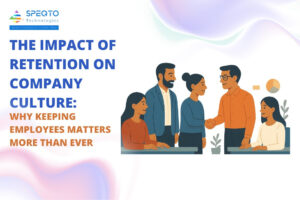
The Impact of Retention on Company Culture: Why Keeping Employees Matters More Than Ever

Khushi Kaushik

08 dec, 2025

In today’s competitive business landscape, organizations are investing heavily in hiring the best talent—
but the real challenge begins after onboarding. Employee retention is no longer just an HR metric;
it has become a defining factor that shapes the overall company culture. When employees stay, grow,
and thrive within an organization, the culture naturally becomes stronger, more inspiring, and more
aligned with long-term success.

How Retention Influences Company Culture

1. Stability Encourages Trust and Transparency

When employees remain with a company for the long term, it fosters a sense of stability.
Teams become more cohesive, communication improves, and employees feel more comfortable sharing
ideas and feedback. This trust-rich environment nurtures a culture where people collaborate confidently,
knowing they are valued and secure.

2. Long-Term Employees Strengthen Core Values

Every organization has core values—but they only become real when employees live them daily.
High retention allows individuals to internalize these values, model them for new team members,
and ensure that the essence of the company remains intact. This leads to a culture rooted in authenticity
rather than slogans.

3. Lower Turnover Leads to Higher Productivity and Engagement

A revolving door of talent disrupts workflow and damages morale. When employees stay, they become
deeply familiar with systems, processes, and expectations. This expertise boosts efficiency and creates
a culture of high performance. Engaged employees uplift others, creating a positive cycle of motivation.

4. Retention Enhances Leadership Development

Organizations with strong retention create more opportunities for internal growth.
Employees who stay longer are more likely to take on leadership roles, mentor newcomers,
and contribute to succession planning. This continuity shapes a culture where learning,
development, and career progression feel attainable for everyone.

5. Reduced Hiring Pressure Supports a Positive Work Environment

Constant recruitment often indicates deeper cultural issues—overwork, unresolved conflicts,
unclear expectations, or poor leadership. When retention improves, HR and management can shift
their focus from firefighting to building proactive initiatives such as wellness programs,
employee recognition strategies, and culture-building activities.

How Strong Retention Positively Transforms Workplace Culture

Improved Team Dynamics: High retention keeps teams together longer, strengthening collaboration and relationships.

Enhanced Employee Loyalty: Employees who feel valued naturally become ambassadors of the culture.

A More Supportive & Positive Atmosphere: Secure employees contribute openly, support peers, and engage in cultural initiatives.

Better Candidate Attraction: A stable, retention-focused culture attracts high-quality talent through positive reputation.

Strategies to Improve Retention and Strengthen Culture

  • Offer continuous learning & upskilling opportunities
  • Create clear career paths and promotion frameworks
  • Establish transparent communication channels
  • Recognize and reward employee contributions regularly
  • Promote a healthy work-life balance and flexible policies
  • Encourage managers to build strong, empathetic relationships
  • Conduct regular feedback surveys and take meaningful action

Conclusion

Retention and company culture are deeply interconnected—each reinforcing the other.
When organizations invest in keeping employees engaged, appreciated, and supported,
they build not only a stable workforce but a culture that drives long-term success.
Strong retention is more than an HR win; it is a cultural anchor that defines who you are
as a company and what you stand for.

RECENT POSTS

Beyond the Battlefield: Architecting Your Web App with Optimal SSR or CSR Rendering

Beyond the Battlefield: Architecting Your Web App with Optimal SSR or CSR Rendering Gaurav Garg 06 March 2026 In the dynamic landscape of web development, a fundamental architectural decision often dictates the success and user experience of a web application: the choice between Server-Side Rendering (SSR) and Client-Side Rendering (CSR). This isn’t merely a technical […]

How IT Companies Can Win Global Clients in 2026

How IT Companies Can Win Global Clients in 2026   Chirag Verma 06/03/2026 In 2026, the global technology market is more competitive and opportunity-rich than ever before. Businesses across industries are searching for reliable IT partners who can help them innovate, scale, and stay ahead in an increasingly digital world. For IT companies, winning global […]

The Human Side of AI: How HR Leaders Will Shape the Future of Work in 2026

The Human Side of AI: How HR Leaders Will Shape the Future of Work in 2026 Khushi Kaushik 06 march, 2026 Introduction As we step into 2026, the workplace is evolving faster than ever before. Artificial Intelligence, automation, remote work, and digital collaboration tools are transforming how organizations operate. But amid all this innovation, one […]

Socket.IO Security Unveiled: Mastering Authentication & Authorization for Robust Real-time Applications

Socket.IO Security Unveiled: Mastering Authentication & Authorization for Robust Real-time Applications Divya Pal 4 February, 2026 In the dynamic landscape of modern web development, real-time applications have become indispensable, powering everything from chat platforms to collaborative editing tools. At the heart of many of these interactive experiences lies Socket.IO, a powerful library enabling low-latency, bidirectional […]

Prisma ORM in Production: Architecting for Elite Performance and Seamless Scalability

Prisma ORM in Production: Architecting for Elite Performance and Seamless Scalability Shubham Anand 16 February 2026 In the rapidly evolving landscape of web development, database interaction stands as a critical pillar. For many modern applications, Prisma ORM has emerged as a powerful, type-safe, and intuitive tool for interacting with databases. However, transitioning from development to […]

POPULAR TAG

POPULAR CATEGORIES