
Loading...

Warning: Undefined array key "post_id" in /home/u795416191/domains/speqto.com/public_html/wp-content/themes/specto-fresh/single.php on line 22

React in 2025: RSC, streaming SSR, and when to use client components

Gaurav Garg

14/09/2025

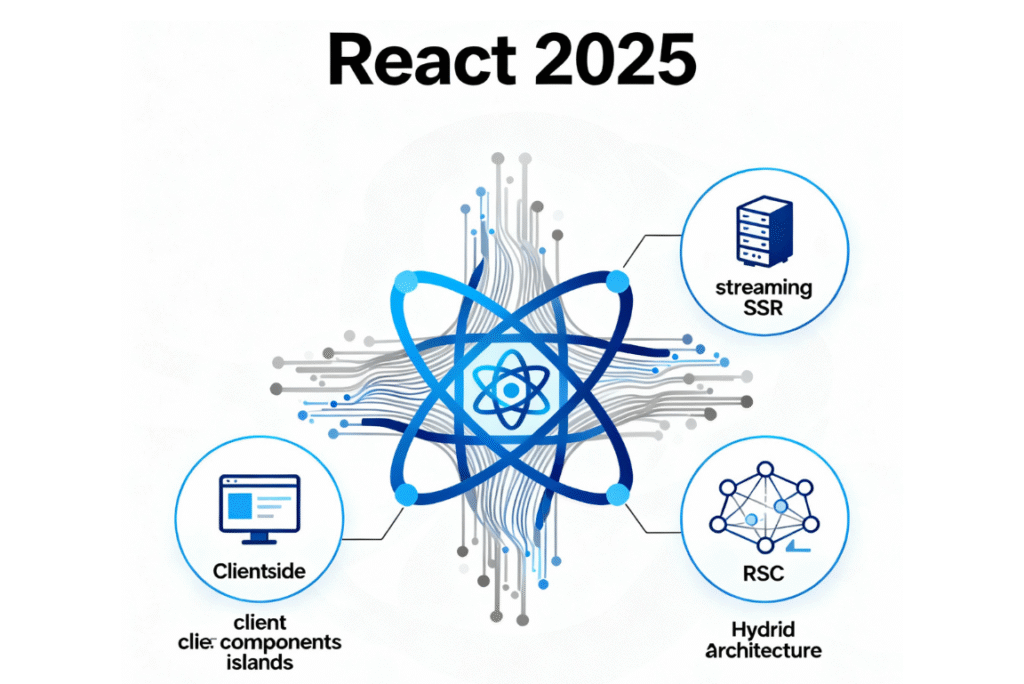
React in 2025 blends server-first rendering with selective client interactivity to ship less JavaScript, speed up initial loads, and keep UI responsive under real-world constraints. The core ideas are React Server Components (RSC) to render and fetch on the server, streaming SSR to progressively send UI, and client components only where interactivity or browser APIs are required.

Brief explanation

React Server Components render on the server and send a lightweight payload to the browser, trimming client bundles and avoiding data-fetch waterfalls. Streaming SSR progressively streams HTML and RSC payloads so users see content quickly, while client components provide interactivity where needed. The sweet spot in 2025 is a server-first tree with clear, intentional client boundaries.

1. Problem Statement
  • Slow initial load from large JS bundles and client-only data fetching waterfalls in complex apps.
  • Overusing client components for all UI leads to heavy hydration costs and sluggish interactions on lower-end devices.
  • Confusion about when to use RSC vs SSR vs client components, causing architecture sprawl and inconsistent performance.
  • Data fetching patterns scattered across the client increase latency, cache misses, and duplicated fetch logic.
  • SEO and time-to-first-byte targets are hard to meet without streaming and server-side composition.
2. Approach to Resolve
  • Default to server-first: make most components server components; move data fetching and heavy computation to the server.
  • Stream early, hydrate late: use streaming SSR with Suspense boundaries to show content quickly and hydrate interactive islands afterward.
  • Draw explicit client boundaries: mark components ‘use client’ only when they need interactivity, browser APIs, mutable state, or effects.
  • Co-locate data on the server: fetch in server components close to their UI; pass only serializable props to client components.
  • Design with Suspense: wrap slow data paths in Suspense to enable progressive rendering and smoother transitions.
3. Tools & Techniques to Follow
  • React Server Components with Suspense for server-rendered data UI and interleaving with client components.
  • Streaming SSR in modern React frameworks to progressively send HTML and the RSC payload.
  • Profiling and bundle analysis to identify heavy client components and reduce client-side JavaScript.
  • Server actions or RPC endpoints to handle mutations while keeping client code light and focused.
  • Caching layers (route cache, fetch cache, CDN) configured on the server side for fast, repeatable responses.
 4. Tips to Enhance UX & Engagement
  • Data-driven views, lists, and layouts that don’t require client-side state or effects.
  • Interactive widgets needing event handlers, local state, or effects (forms, modals, drag-and-drop, charts with tooltips).
  • Real-time UI requiring websockets or frequent client-side updates.
  • Server shell, client islands: render the page and data on the server; hydrate interactive parts as client islands.
  • Don’t put state/effects in server components; they run only on the server and can’t hold client state.
  • Measure with Core Web Vitals and interaction latency in production, not just lab.
Conclusion

React in 2025 is server-first by default, streaming content fast and hydrating interactivity where it matters. By keeping most UI as server components, using streaming SSR with Suspense, and reserving client components for genuine interactivity, teams ship less JavaScript, improve time-to-first-byte and interactivity, and maintain a clearer separation of concerns. This balance leads to faster, more resilient apps that scale with features and traffic.

Read More>>

RECENT POSTS

Beyond the Battlefield: Architecting Your Web App with Optimal SSR or CSR Rendering

Beyond the Battlefield: Architecting Your Web App with Optimal SSR or CSR Rendering Gaurav Garg 06 March 2026 In the dynamic landscape of web development, a fundamental architectural decision often dictates the success and user experience of a web application: the choice between Server-Side Rendering (SSR) and Client-Side Rendering (CSR). This isn’t merely a technical […]

How IT Companies Can Win Global Clients in 2026

How IT Companies Can Win Global Clients in 2026   Chirag Verma 06/03/2026 In 2026, the global technology market is more competitive and opportunity-rich than ever before. Businesses across industries are searching for reliable IT partners who can help them innovate, scale, and stay ahead in an increasingly digital world. For IT companies, winning global […]

The Human Side of AI: How HR Leaders Will Shape the Future of Work in 2026

The Human Side of AI: How HR Leaders Will Shape the Future of Work in 2026 Khushi Kaushik 06 march, 2026 Introduction As we step into 2026, the workplace is evolving faster than ever before. Artificial Intelligence, automation, remote work, and digital collaboration tools are transforming how organizations operate. But amid all this innovation, one […]

Socket.IO Security Unveiled: Mastering Authentication & Authorization for Robust Real-time Applications

Socket.IO Security Unveiled: Mastering Authentication & Authorization for Robust Real-time Applications Divya Pal 4 February, 2026 In the dynamic landscape of modern web development, real-time applications have become indispensable, powering everything from chat platforms to collaborative editing tools. At the heart of many of these interactive experiences lies Socket.IO, a powerful library enabling low-latency, bidirectional […]

Prisma ORM in Production: Architecting for Elite Performance and Seamless Scalability

Prisma ORM in Production: Architecting for Elite Performance and Seamless Scalability Shubham Anand 16 February 2026 In the rapidly evolving landscape of web development, database interaction stands as a critical pillar. For many modern applications, Prisma ORM has emerged as a powerful, type-safe, and intuitive tool for interacting with databases. However, transitioning from development to […]

POPULAR TAG

POPULAR CATEGORIES