

Loading...

In-House Team vs IT Outsourcing Partner: What BFSI Leaders Should Actually Weigh Before Deciding

Every CTO or Head of Technology at a bank, NBFC, or fintech eventually hits this question: do we build our own tech team, or do we bring in an outsourcing partner? At Speqto Technologies, we’ve sat on both sides of this conversation – as the partner being evaluated, and as advisors helping clients think through their own build-vs-partner decisions. There’s no universal right answer, but there is a right answer for your specific stage, compliance load, and growth timeline.

Let’s skip the generic pros-and-cons list you’ve probably already read and get into what actually matters for BFSI and fintech specifically.

The compliance reality changes the math

Unlike a typical SaaS product, a lending platform or payments app has RBI guidelines, data localization rules, and audit trails to worry about from day one. We worked with an NBFC client that had hired three in-house developers to build their loan origination system. Six months in, they realized none of their team had prior experience with RBI’s digital lending guidelines or how to structure consent-based data flows for account aggregators. They ended up pausing development for two months just to retrain and restructure the architecture.

When we took over as their outsourcing partner, we already had engineers who’d built KYC and consent workflows for two other lending clients. That prior exposure alone saved them roughly 10-12 weeks of trial and error. This is the part in-house hiring often misses – domain-specific compliance knowledge is not something you can post a job listing for and get overnight.

Where in-house genuinely wins

We’re not going to pretend outsourcing is always the answer. If your core product IS the technology – say you’re a fintech building a proprietary risk-scoring engine that’s your entire competitive moat – you want that logic owned, understood, and controlled by people who eat, sleep, and stay at your company for years. One of our clients, a credit-scoring startup, kept their core algorithm team fully in-house and only outsourced peripheral work like their customer dashboard and admin panel to us. That split made sense because their IP lived in the algorithm, not the dashboard.

In-house also wins when:

  • You need people embedded in daily product decisions, sitting in the same standups as compliance and risk teams
  • Your product roadmap changes weekly based on regulatory updates, and you can’t afford communication lag
  • You’re planning to raise a large funding round and investors want to see a strong core tech team as part of the valuation story

Where outsourcing actually makes more sense

For most BFSI and fintech companies, especially those between seed stage and Series B, outsourcing wins on speed and cost predictability. Hiring a single senior backend engineer with fintech experience in India right now takes anywhere from 6 to 10 weeks, and that’s before onboarding. We recently helped a payments startup launch their UPI-based collection product in 14 weeks flat – a timeline that would have been impossible if they’d tried to hire and ramp up an in-house team from scratch, because half that time would’ve gone into recruitment alone.

Outsourcing also make sense when:

  • You need to scale a team up or down based on project phases – heavy during build, lighter during maintenance
  • You want access to niche skills (say, someone who’s actually implemented OCEN or Account Aggregator integrations) without committing to a full-time hire
  • Your budget needs to be predictable on a monthly basis rather than absorbing hiring, attrition, and benefits costs

The hybrid model most of our BFSI clients actually land on

Honestly, the cleanest answer we’ve seen work in practice isn’t “either/or” – it’s a hybrid. Keep a lean in-house core (usually a CTO, one or two senior architects, and a product owner) who understand your regulatory environment deeply, and bring in an outsourcing partner for execution-heavy work: development, QA, DevOps, and specialized integrations.

One of our banking clients runs exactly this model. Their 4-person in-house team owns architecture decisions and stakeholder communication with RBI-facing teams. Our 12-person squad handles the actual sprint execution, testing, and infrastructure. Eighteen months in, they’ve shipped three major releases without a single compliance flag, and their in-house headcount cost is roughly 40% lower than if they’d tried to build all of it internally.

Questions to actually ask before deciding

  • Does this component touch our core IP, or is it supporting infrastructure?
  • Do we have 4-6 months to spare for hiring and ramp-up, or do we need to ship in 8-10 weeks?
  • Does our compliance and audit team need daily in-person access to the developers?
  • What happens to this team’s workload after the initial build phase – do we still need them full-time?

The decision isn’t about which model is “better” in the abstract. It’s about matching the model to what you’re building, how fast you need it, and how much regulatory risk sits inside the code itself. If you’re weighing this decision right now for a BFSI or fintech product, we’re happy to walk through your specific situation – sometimes the honest answer is that you don’t need us at all, and we’ll tell you that too.

RECENT POSTS

In-House Team vs IT Outsourcing Partner: What BFSI Leaders Should Actually Weigh Before Deciding

Every CTO or Head of Technology at a bank, NBFC, or fintech eventually hits this question: do we build our own tech team, or do we bring in an outsourcing partner? At Speqto Technologies, we’ve sat on both sides of this conversation – as the partner being evaluated, and as advisors helping clients think through […]

The Real Cost of Delaying Digital Transformation: What Mid-Size BFSI Firms Are Losing Every Quarter

Every mid-size NBFC, cooperative bank, or insurance broker we’ve worked with at Speqto Technologies has, at some point, said some version of the same thing: “We’ll get to the digital overhaul next year, once things settle down.” The problem is, things never settle down. And the invoice for waiting keeps growing quietly in the background […]

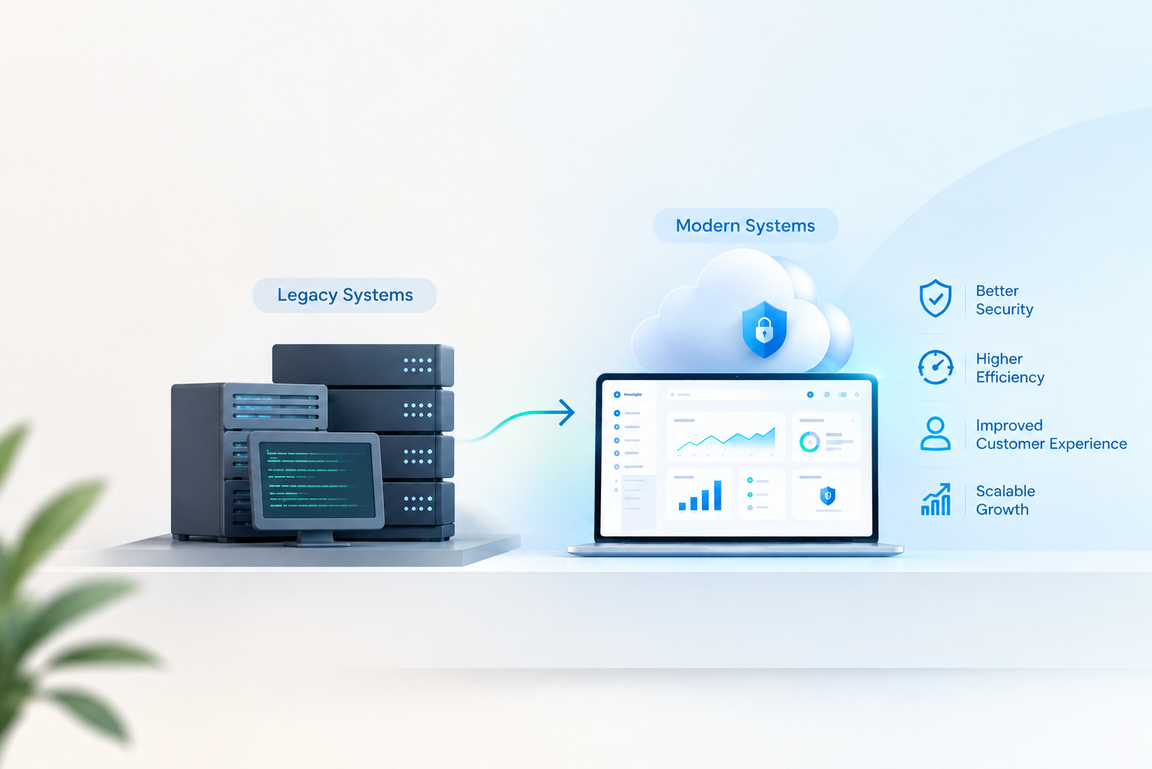
How BFSI Companies Can Modernize Legacy Systems Without Disrupting Operations

Every BFSI leader we talk to at Speqto Technologies says some version of the same thing: “Our core system works, but it’s holding us back.” Then in the next breath: “But we can’t afford even four hours of downtime.” That tension between needing to modernize and being terrified of breaking something that processes millions of […]

7 Signs Your BFSI Business Needs a Digital Transformation Partner (Not Just Another IT Vendor)

Every BFSI leader we talk to has already “done” digital transformation in some form — a new CRM here, a mobile app there, maybe a chatbot bolted onto the website. Yet the same complaints keep surfacing: loan approvals still take days, reconciliation is manual, and the leadership team is making decisions off a spreadsheet someone […]

Why Custom Software Beats Off-the-Shelf Tools for Growing Businesses

A few months back, a mid-sized NBFC came to us at Speqto with a problem that’s more common than most people admit out loud: they had outgrown their loan management software, but nobody wanted to say it directly. Instead, the conversation was framed as “we need better reporting” or “the CRM feels slow.” Two calls […]

POPULAR TAG

POPULAR CATEGORIES