
Loading...

Collaborating in a Multi-Disciplinary Tech Team: Frontend and Beyond

Gaurav Garg

28-10-2025

Frontend and Beyond

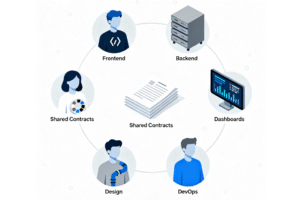
Cross-functional collaboration is a force multiplier for product velocity and quality when teams align on shared goals, clear interfaces, and feedback loops across design, frontend, backend, DevOps, data, and QA. High-performing teams in 2025 emphasize structured rituals, shared artifacts (design systems, API contracts), and CI/CD to shorten iteration cycles and reduce handoff risks.

Modern teams work best as integrated pods where UX, engineering, and product share context from discovery to delivery, reducing rework and increasing user impact. The backbone is a common language: definitions of done, interface contracts, and visible dashboards that make bottlenecks obvious and solvable together.​

1. Problem Statement
  • Hand-offs create ambiguity: missing specs, unclear API shapes, and drifting requirements cause rework and delays between frontend, backend, and design. Teams need shared artifacts and earlier alignment to avoid costly churn.​
  • Siloed workflows slow feedback: long review queues and late QA find problems when change is expensive, hurting quality and morale
  • Tools without agreements fail: chat, tickets, and whiteboards help only when paired with team-level agreements on cadence, ownership, and standards
  • UX and Dev drift: design intent and implementation diverge without a strong design system and pragmatic handoff, increasing inconsistencies and accessibility debt
2. Approach to Resolve
  • Form cross-functional pods: embed design, frontend, backend, QA, and a product partner with shared OKRs, running short discovery-to-delivery loops to keep context and accountability tight.​
  • Establish shared contracts early: use API schemas, component specs, and acceptance criteria before implementation; keep them versioned and visible to all
  • Make work observable: CI/CD pipelines, feature flags, and dashboards for builds, tests, and release health enable fast, low-risk iteration and rollbacks.​
  • Operationalize design collaboration: adopt a design system, agree on accessibility standards, and use structured handoff tools and checklists to close the design–dev gap
3. Tools & Techniques to Follow
  • Design and handoff: Figma libraries, design tokens, and Storybook to connect visual intent to coded components and reduce drift across teams
  • API and data contracts: OpenAPI/JSON Schema, mock servers, and contract tests so frontend and backend can develop in parallel with fewer surprises
  • DevOps flow: trunk-based development, CI for lint/tests/type-checks, CD with canary or feature flags, and clear rollbacks for safe, frequent releases
  • Collaboration stack: Slack/Teams + Jira/Linear + Notion/Confluence for rituals, decisions, and living docs; virtual whiteboards for discovery
 4. Tips to Enhance UX & Engagement
  • Start with the interface: align on API shapes, error models, and loading states before writing code; build mocks and stubbed endpoints to unblock frontend quickly
  • Design system as contract: treat components and tokens as shared infrastructure, with joint ownership and accessibility as a non-negotiable requirement
  • Shorten the loop: weekly demos with stakeholders, daily async updates, and pre-merge checks keep work visible, reduce surprises, and build trust.​
  • Define “done” together: include tests, a11y checks, performance budgets, and observability hooks in the definition of done to prevent quality regressions.​
  • Normalize trade-offs: document decisions and rationale (speed vs polish, scope vs date) to reduce debate churn and align future work without re-litigating
Conclusion

Cross-functional excellence depends on shared contracts, observable delivery, and a culture of rapid, respectful feedback where design intent and engineering reality meet. By embedding multidisciplinary pods, versioning interfaces, and investing in design systems and CI/CD, teams ship faster with fewer surprises—and create products that are coherent, accessible, and resilient in production.

RECENT POSTS

The Impact of Retention on Company Culture: Why Keeping Employees Matters More Than Ever

The Impact of Retention on Company Culture: Why Keeping Employees Matters More Than Ever Khushi Kaushik 08 dec, 2025 In today’s competitive business landscape, organizations are investing heavily in hiring the best talent— but the real challenge begins after onboarding. Employee retention is no longer just an HR metric; it has become a defining factor […]

How a BDE Connects Business Vision With Technology

How a BDE Connects Business Vision With Technology Kumkum Kumari                                                              21/11/2025At Speqto, we work with organizations that are constantly evolving entering new markets, scaling operations, or […]

Apache JMeter Demystified: Your 7-Stage Blueprint for a Seamless First Performance Test

Apache JMeter Demystified: Your 7-Stage Blueprint for a Seamless First Performance Test Megha Srivastava 21 November 2025 In the intricate world of software development and deployment, ensuring a robust user experience is paramount. A slow application can quickly deter users, impacting reputation and revenue. This is where Apache JMeter emerges as an indispensable tool, offering […]

STRIDE Simplified: A Hands-On Blueprint for Pinpointing Software Threats Effectively

STRIDE Simplified: A Hands-On Blueprint for Pinpointing Software Threats Effectively Megha Srivastava 21 November 2025 In the intricate landscape of modern software development, proactive security measures are paramount. While reactive incident response is crucial, preventing vulnerabilities before they become exploits is the hallmark of robust software engineering. This is where threat modeling, and specifically the […]

From Static to Streaming: A Practical Developer’s Guide to Real-time Applications Using GraphQL Subscriptions

From Static to Streaming: A Practical Developer’s Guide to Real-time Applications Using GraphQL Subscriptions Shakir Khan 21 November 2025 The Paradigm Shift: From Static to Streaming Experiences In an era where user expectations demand instant gratification, the web has rapidly evolved beyond its static origins. Today, a modern application’s success is often measured by its […]

POPULAR TAG

POPULAR CATEGORIES